What I Observe in a First Pilates Session
Written by Abdul Kalam, Pilates instructor · For educational purposes only; not medical advice.
The first session includes more conversation and observation than later sessions. I explain this to the client. We review the intake information, discuss what brought them to the studio, and begin with accessible movement so that both of us can understand the starting point more clearly.
I observe ordinary standing, transitions, breathing during movement, responses to introductory exercises, and the client’s own account of what they are experiencing. These are preliminary observations. They are not a diagnosis, and they are not treated as a complete explanation of the client’s history.
The Intake Conversation
Before the session, the client completes an intake form covering relevant movement experience, injuries, surgeries, health conditions, current concerns, and aspects of daily life that may affect participation. I read it before we begin and ask questions where something requires clarification.
The form depends on what the client knows and chooses to report. My observations depend on what is visible during a particular appointment. The client’s explanation, written history, and movement observation provide different kinds of information. None replaces the others.
Where pain, recent injury, surgery, a significant medical history, or another concern falls outside my scope, I may ask for medical assessment or clearance before proceeding. The first session is not used to diagnose a condition or test whether medical advice can be ignored.
Standing as One Preliminary View
I may ask the client to stand naturally while I observe their general position at that moment. I may notice the relationship of the head, shoulders, ribcage, pelvis, legs, and feet, or whether weight appears to be distributed differently from side to side.
I record what is visible without assuming why it is present. A difference in shoulder height does not tell me that one side has been overused. A particular pelvic position does not establish the condition of the spine or muscles. Standing provides one limited view, and its meaning is tested against movement, client report, and observations made over subsequent sessions.
Transitions and Introductory Movement
Simple transitions can provide useful information. I observe how the client approaches the apparatus, changes position, responds to an unfamiliar instruction, and communicates uncertainty or discomfort. I may notice whether the movement is smooth or hesitant, whether additional support is used, whether breath continues, and whether the two sides appear to respond differently.
I do not assign a cause from one observation. A client may use momentum, move cautiously, or hold their breath for many possible reasons, including unfamiliarity with the studio. The first session is partly about allowing that unfamiliarity to reduce.
Breathing During Movement
I observe visible movement of the ribcage and shoulders, whether the breath appears to continue during an exercise, and whether the client reports breathlessness, discomfort, or difficulty coordinating breath with movement.
This is not respiratory assessment. I am not diagnosing a breathing pattern or inferring its cause from desk work, posture, stress, or any other single factor. I use the observation only to decide how much breathing instruction is useful within the movement work and whether anything the client reports requires medical attention.
The First Exercises
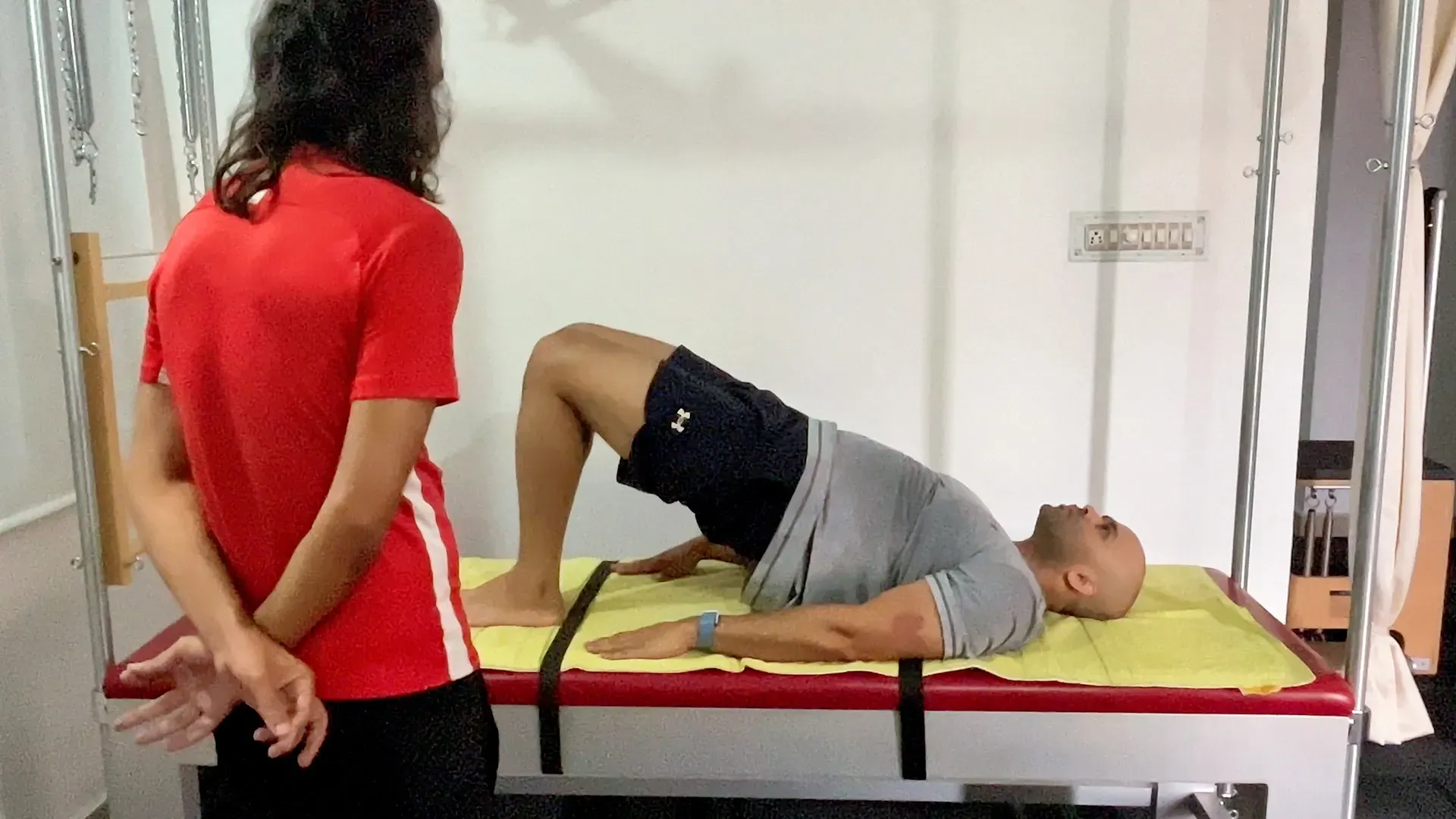
The first exercises are selected to be accessible and informative rather than impressive. They help me observe how the client interprets an instruction, organises effort, responds to the apparatus, and describes what they feel.
I rarely demonstrate a complete exercise during private instruction because I usually need to remain in a position where I can watch the client. Where a brief demonstration would clarify how to approach the apparatus, the direction of a movement, a transition, or a safety procedure, I may use one. Demonstration, verbal cueing, touch with consent, and changes to the setup are all tools; none is used automatically.
The first movement is not a test the client is expected to pass. Difficulty, hesitation, or an unclear response may simply mean that the instruction, setup, or exercise needs to change.
What I Know at the End
By the end of the first session, I have an initial working picture: which movements were accessible, which instructions were understood, what the client reported, and which apparatus or starting positions may be useful in the next few sessions.
That picture remains provisional. A single session cannot establish a complete movement profile. Initial observations may change as the client becomes more familiar with the studio, understands the language of the method, and moves under different conditions.
I do not present the first session as a verdict about what is wrong with the client. It is the beginning of a working relationship in which information is gathered, discussed, and revised over time.
The first session gives me a starting point, not a final explanation. What I observe is considered alongside what the client reports and remains open to revision as the work continues.