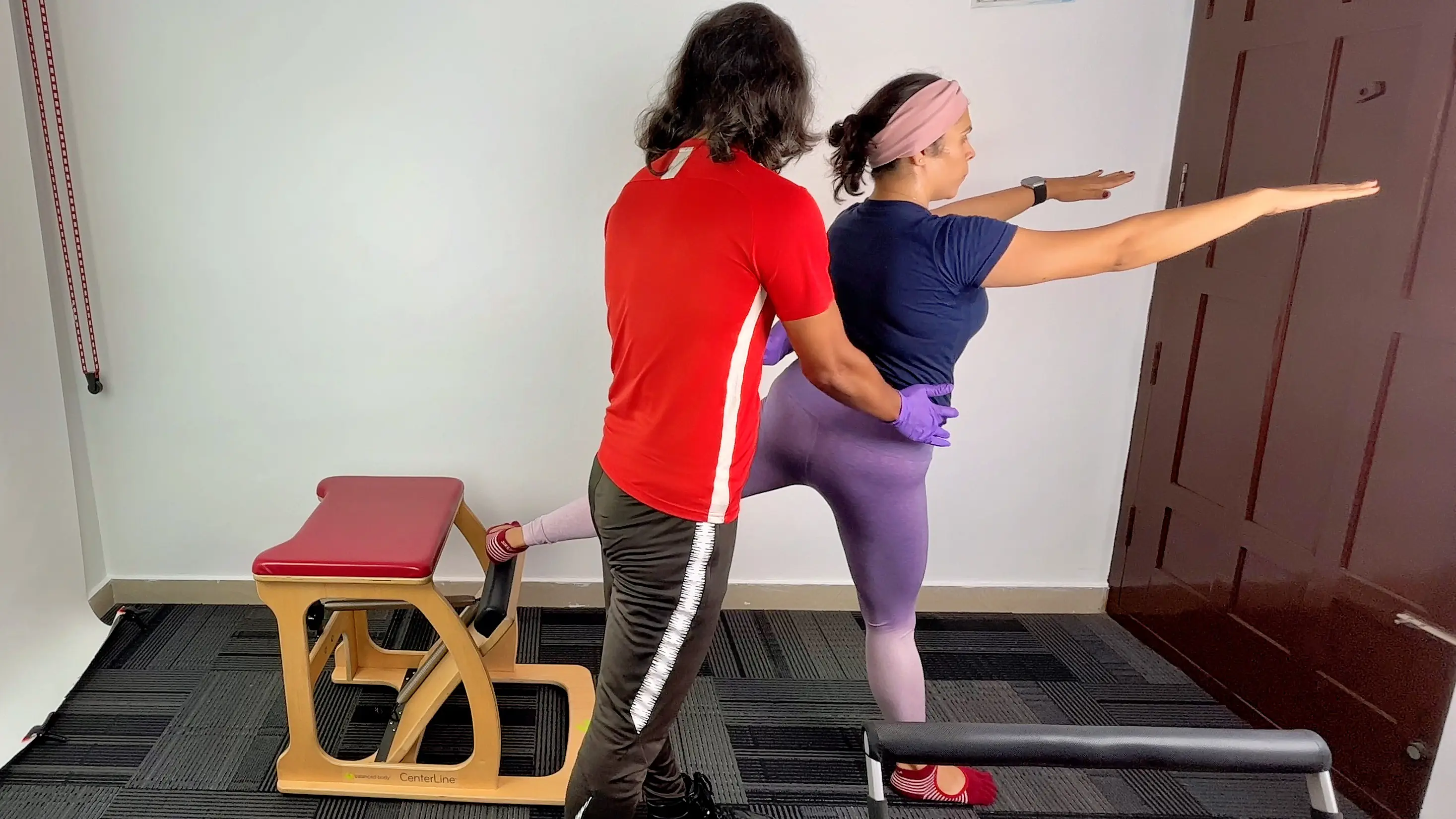
Pilates instructor working closely with a client at a private studio in Bengaluru

Touch and Spotting in Pilates Instruction

Written by Abdul Kalam, Pilates instructor · For educational purposes only; not medical advice.

Of all the tools I use as an instructor, touch and spotting are the ones I think about most carefully. Cueing gets discussed often. Sequencing gets discussed often. The apparatus, the principles, the breath — these have well-developed conversations around them. Touch and spotting do not, and yet they are central to what happens in a session.

What follows is how I think about both, and how I use them in my own practice. Used well, a single touch communicates something that ten verbal cues could not. Used carelessly, it undermines trust and reduces the quality of the work. The difference is not instinct. It is intention.

What Touch Is For

The touch I use in a session is a teaching tool. It is not manual therapy. It is not physical rehabilitation. It is a way of communicating to the body directly when words have not landed, when the nervous system needs a different kind of signal, or when the exercise asks for a sensory reference that language cannot deliver.

An example. A client is doing Elephant on the Reformer and keeps using their hands to push rather than initiating from the hip. I can say "move from the hip" repeatedly and nothing changes. If I place my hand on the shoulder and hold it — not forcefully, just present — the client can no longer use the shoulder to initiate. The body finds the hip. The instruction that words could not deliver, the hand delivered in a moment.

On the Wunda Chair, in the Washerwoman series, the same principle applies. When a client pumps the pedal primarily with their arms and hands, I place a hand gently under the belly or against the upper back and ask them to push into it — to push the stomach away or press the back into my hand while they continue the movement. The touch gives the body a target it can respond to immediately. It clarifies the intention in a way that description cannot.

That is what touch does at its best. It makes the invisible visible. It gives the body a felt reference for something the mind has heard but not yet understood.

What I Am and What I Am Not

I want to be explicit about what touch in this studio is and is not, because clients sometimes arrive with mixed expectations. Some have been to physiotherapists. Some have had manual therapy. Some have had massage. Pilates instruction looks superficially adjacent to all of these. It is not any of them.

I am a movement professional. My job is to move the client — to take them through the work and into ranges of movement that they cannot safely or productively reach on their own. I am not a masseur. I am not a physiotherapist. I do not heal injuries. I do not release fascia. I do not work on tissue. The touch I use is in service of movement, and only of movement.

This shapes what the touch is allowed to do. A client may be stretched a little during the work — that is part of taking the body through a fuller range than habitual movement allows. But they do not come to me to be stretched. They come to me to be moved. The stretching is a small consequence of the work, not its purpose. Anything more — sustained passive stretching, hands-on tissue work, treatment-style intervention — is outside my scope and outside what this studio is for.

The amount of touch I use is therefore limited and purposeful. If I find myself constantly fiddling with the client's body to get them through movements they are not ready for, the problem is not in the touch. The problem is that I have asked the body to do something it has not yet been prepared for. The right response is to step back, simplify the exercise, and build the foundation that lets the body do the movement on its own. The touch is a small assist at the edge of what the client can do — not a hand that drags them through what they cannot.

The goal is to help the client find their own safe range and then, as we say in Pilates, to milk the exercise to its maximum within that range. A small cue, a small touch, a small adjustment of position — anything that lets the body find a little more length, a little more engagement, a little more clarity within what it is already capable of. That is the work. Not pulling the client through movements that exceed their current capacity.

How My Touch Changes as a Client Progresses

The nature and amount of touch I use changes significantly depending on where the client is in their practice. This is not a small variation — it is a fundamental shift in what the touch is for.

With a new client, my touch is primarily guiding and containing. The client does not yet know the equipment. They do not know how their body is expected to move. They may not know how to get on and off the apparatus safely. Touch at this stage is about giving them the experience of the correct movement — the range, the rhythm, the dynamic — before they have the coordination to produce it independently. It is also about safety: containing the movement within appropriate limits, holding a position steady so the client can feel what neutral is, being physically present in a way that communicates careful attention to their safety.

As the client's practice develops, the guiding touch reduces and the quality of the touch shifts. It becomes more about encouraging opposition — creating a surface to push against or pull away from, deepening the stretch, inviting more length or more engagement in a specific area. The client now knows what the exercise is doing. The touch is refining what the body can get from it.

At an advanced level, my physical touch is minimal or absent. The client has ownership of the work. They can self-correct, they know the apparatus, and they move with a level of body awareness that does not require external input to find the exercise. At this stage my presence is primarily for safety — being ready if something unexpected happens — and the instruction is almost entirely verbal, focused on the fine detail of what is already working well.

The progression of my touch mirrors the client's progression toward independence. The goal was always to make the touch progressively less necessary.

This is also why I am cautious about touching too much, even when it would technically help. A client who is constantly assisted into the right position, constantly adjusted by hand, constantly given hands-on support through every challenging moment, becomes dependent on that support to perform the work. I become part of the apparatus. When that pattern sets in, the client cannot practice without me in the room — and that is a failure of teaching, not a feature of it.

The same principle applies to the operational details of the studio. When a client is new, I change the springs for them. I set up the apparatus before they arrive at it. I make the adjustments between exercises. This is correct for the early sessions. They do not yet know which spring weight is appropriate, what the gear positions are for, or how to handle the equipment safely. But after a couple of sessions I expect them to start doing this work themselves. Reading their own body, choosing their own spring weight, setting up the apparatus for the next exercise. If I am still doing all of this in session twenty, something has gone wrong in the teaching.

The Kinds of Touch I Use

Not all touch does the same thing. The touches I use fall into a few distinct categories, each doing different work.

Guiding touch — I manually give the client the experience of the correct movement: the range of motion, the rhythm, the dynamic quality of the exercise. The hand is active and directive.

Containing touch — I limit or hold. A hand around the shoulder to prevent it from initiating movement, a hand at the hip to prevent the pelvis from shifting. The hand is not pulling or pushing; it is present as a boundary.

Inviting touch — an encouragement to go deeper. A hand that creates a surface to move toward, a pressure that asks the body to extend further into the exercise. It is an invitation, not a demand.

Opposing touch — I create stabilisation by placing resistance against one part of the body while another part moves, reinforcing the principle of opposition that underlies most of the method's exercises.

Lengthening touch — I create space. A hand that encourages the spine to elongate, the neck to release, the limb to reach further. It communicates direction rather than resistance.

There is also a kind of non-physical touch that is part of how I work. Using the client's name, making direct eye contact, staying physically close and attentive — these communicate presence and care in a way that affects how the client experiences the session. Being close to the client without making physical contact is itself a form of touch. The quality of my attention is felt even when no hands are involved.

How I Approach Permission and Consent

The touch I use is always offered, not imposed. With a new client, I ask permission before making physical contact. It does not need to be a formal declaration — it can be as simple as "I am going to place my hand on your shoulder to help you feel this" before doing so. What matters is that the client is informed and has the chance to decline.

If at any point I sense resistance to touch from a particular client — whether they say so directly or whether I read it in how they respond — I do not touch. Teaching without physical contact is still teaching. Verbal cueing, clear instruction, and attentive presence accomplish most of what touch would accomplish in those situations. Touch supplements good instruction; it does not substitute for it.

The touch is always an invitation for the client to respond — not a manipulation to place their body in a position. The difference is not subtle once I am attentive to it. Manipulation produces a body that has been positioned. An invitation produces a body that has found its own position with guidance. The second produces learning. The first produces compliance.

How I Touch When I Touch

When I do touch a client, a few things hold consistently.

I use an open hand with gentle but firm pressure. A flat, open hand communicates clearly and does not feel intrusive. The pressure is enough to register as directional without feeling forceful.

I touch bony landmarks and major muscle groups — the sacrum, the shoulder blade, the upper back, the hip crest, the belly. I do not touch the head. I am careful with joints — knees, elbows, wrists — unless I have a clear reason. Joints are sensitive, and touching them without purpose creates anxiety rather than clarity.

Every touch I make has a clear purpose. If I cannot articulate in my own mind what the touch is for, I do not make it. Touch without intention is not neutral — it is confusing at best and unsettling at worst.

I follow my verbal cue with touch rather than substituting touch for words. The two work together. I say what I want the body to do, then use the touch to reinforce or clarify that instruction. Touch that arrives without verbal context can leave the client uncertain about what they are supposed to do with the sensation.

I only touch when I am clear about what I am doing. This is not just about experience — it is about being present and clear at the moment of the touch. Distracted or uncertain touch communicates itself to the client's nervous system. If I am not sure what the touch is for, I wait until I am.

What Spotting Is For

Spotting is related to touch but distinct from it. Where touch is a teaching tool — communicating direction, alignment, opposition — spotting is a safety and observation practice. It is my active attention to what the client is doing, whether the apparatus is behaving as expected, and whether intervention is needed.

Spotting involves both eyes and hands. Sometimes I am spotting the client. Sometimes I am spotting the apparatus. Both matter.

When a new client gets on the Reformer for the first time, they do not know that the footbar is movable and can come away if pulled. They have no reason to know this. My foot goes on the frame with the top of the foot pressing into the footbar — not because I expect it to come off, but because it is my responsibility to prevent that possibility before the client has the knowledge to account for it themselves. When I was completing my own assessment as an instructor and was about to teach a client Tendon Stretch, the examiner did not focus on how I taught the exercise. They watched where my foot was when the client was getting on and off the footbar. That safety protocol is the foundation. Everything else builds on it.

How My Spotting Changes as a Client Progresses

At the beginning, my spotting is primarily about basic safety — making sure the client can navigate the apparatus, that the equipment is stable, and that the movements being attempted are within their current capacity. I stay close, attentive, and ready to intervene.

As the exercises become more complex, the demands on spotting actually increase rather than decrease. An advanced client doing control push-up, backbend work, or hybridised exercises requires more precise and more active spotting from me than a beginner doing footwork — not because the beginner needs less care, but because the advanced exercises carry more physical risk if something goes wrong. The speed, range, and mechanical demand of these exercises means I have to be positioned and ready in a way that beginners' work does not require.

On the Wunda Chair, for exercises where the client is moving up and down — the Going Up Front series, for example — I am positioned and ready to hold the client if they lose balance, take a foot off the pedal unexpectedly, or need support through a transition. Being present and positioned is the spotting. My hands may not be needed, but they are ready.

How I Spot — Direct and Indirect

My spotting is not only hands-on. There are two distinct modes I use, and both are necessary.

Direct spotting is hands-on and close — physically supporting the client through a movement, holding them through a transition, being in contact for safety. This is what most people think of when they hear the word.

Indirect spotting is stepping back to see the full picture. Moving around the client to observe from different angles. Checking that the hips are square, that neither foot is pressing harder than the other, that the client is not collapsing into one hip, that the breath is present, that leg circles are tracking through the centre rather than drifting. None of this requires physical contact. It requires me to be watching actively and continuously, not just when something appears to be going wrong.

Both modes are necessary in every session. Direct spotting without indirect spotting misses the patterns that develop over time. Indirect spotting without the readiness for direct spotting is observation without responsibility.

How I Think About Spotting

Some exercises require spotting from me without exception. Any exercise that involves inversion, significant spinal loading, balance on an unstable surface, or a transition the client has not done before — I am present, positioned, and attentive. This is not negotiable regardless of how experienced the client is.

I also try not to over-spot. The goal of spotting, like the goal of touch, is not to make myself necessary to the client's movement. Over-spotting creates dependency — the client moves differently when they know they are being held, and they may not develop the proprioception and confidence the exercise is designed to build. I spot when the exercise requires it or when the client's current capacity makes it appropriate. I step back when neither of those conditions applies.

I tell the client why I am spotting. A client who understands that I am standing close because the exercise has a specific safety consideration — not because I do not trust them — can engage with the spotting as part of their learning rather than experiencing it as surveillance. And I want the client to feel free to tell me that they do not need me close. That conversation is itself a sign of a client who is developing ownership of their practice.

Touch and spotting are not accessories to my teaching. They are the teaching made physical — my knowledge and attention expressed through presence, positioning, and contact. Used with intention and care, they change what a session can produce. Used without either, they are noise.