The Six Principles of Pilates: What They Are and What They Are Not
Written by Abdul Kalam, Pilates instructor · For educational purposes only; not medical advice.
Spend any time reading about Pilates and you will encounter the six principles: centering, control, concentration, precision, breath, fluidity. They appear in books, studio brochures, instructor training programmes, and introductory articles across the internet. They are widely presented as the foundation of the method — the defining qualities that make Pilates what it is.
There is one qualification to this account. The principles do not appear as a six-part list in Joseph Pilates' two published books.
Where the Principles Actually Come From
The six-part framework was codified after Joseph Pilates' death in 1967. A commonly cited source is Philip Friedman and Gail Eisen's 1980 book, The Pilates Method of Physical and Mental Conditioning. The list does not appear in Your Health or Return to Life Through Contrology, although several of its ideas are present throughout Pilates' writing.
This does not make them wrong. As qualities to cultivate during movement practice, they are genuinely useful. The difficulty is not with the principles themselves. It is with the claim that they define what makes Pilates distinctive. Apply these six principles to any structured movement discipline — yoga, golf, swimming, dance — and you will find the same qualities present. They describe good movement practice in general, not Pilates specifically.
What Each Principle Actually Means
Control is the quality the method is built around. The aim is deliberate, coordinated movement rather than fatigue or exertion for its own sake. In apparatus work, this extends to the springs — the practitioner controls the springs, not the other way around. Movement without control often reveals compensation. Movement with control gives the teacher and client something clearer to work with.
Concentration is what makes the mind-body connection real rather than conceptual. The aim is to focus genuinely on what the body is doing — during the movements and during the transitions between them. This is harder than it sounds in an age of constant distraction. A session of real concentration on the body is valuable in itself, separate from whatever physical development accompanies it.
Centering and stabilisation — in the way I was taught, the centre refers broadly to the trunk, pelvis and upper legs, not only the abdominal wall. Movement of the limbs is organised in relation to that centre. Centering also has a practical dimension on the apparatus: position, weight distribution and symmetry.
Precision concerns the purpose and organisation of each movement. It is not perfectionism; it is moving intentionally rather than accumulating careless repetitions.
Breath is woven into every movement. Conscious breathing supports the direction of effort, focuses attention, and gives the body another way to work with unnecessary tension. Joseph Pilates wrote simply: "Above all, learn how to breathe correctly." In practice, breath is also useful to observe — how a client breathes at rest, before any instruction is given, often reveals something about how they are holding or organising themselves.
Fluidity refers to dynamic, graceful movement — and to the seamless transitions between exercises. A well-conducted session maintains a continuous thread of movement and attention from start to finish. The more each part of a movement is threaded into the next, the more coherent the practice becomes and the deeper the mind-body connection.
Another Principle in the Way I Was Taught
There is another principle that does not appear in the standard six but is central to the way I was taught: opposition.
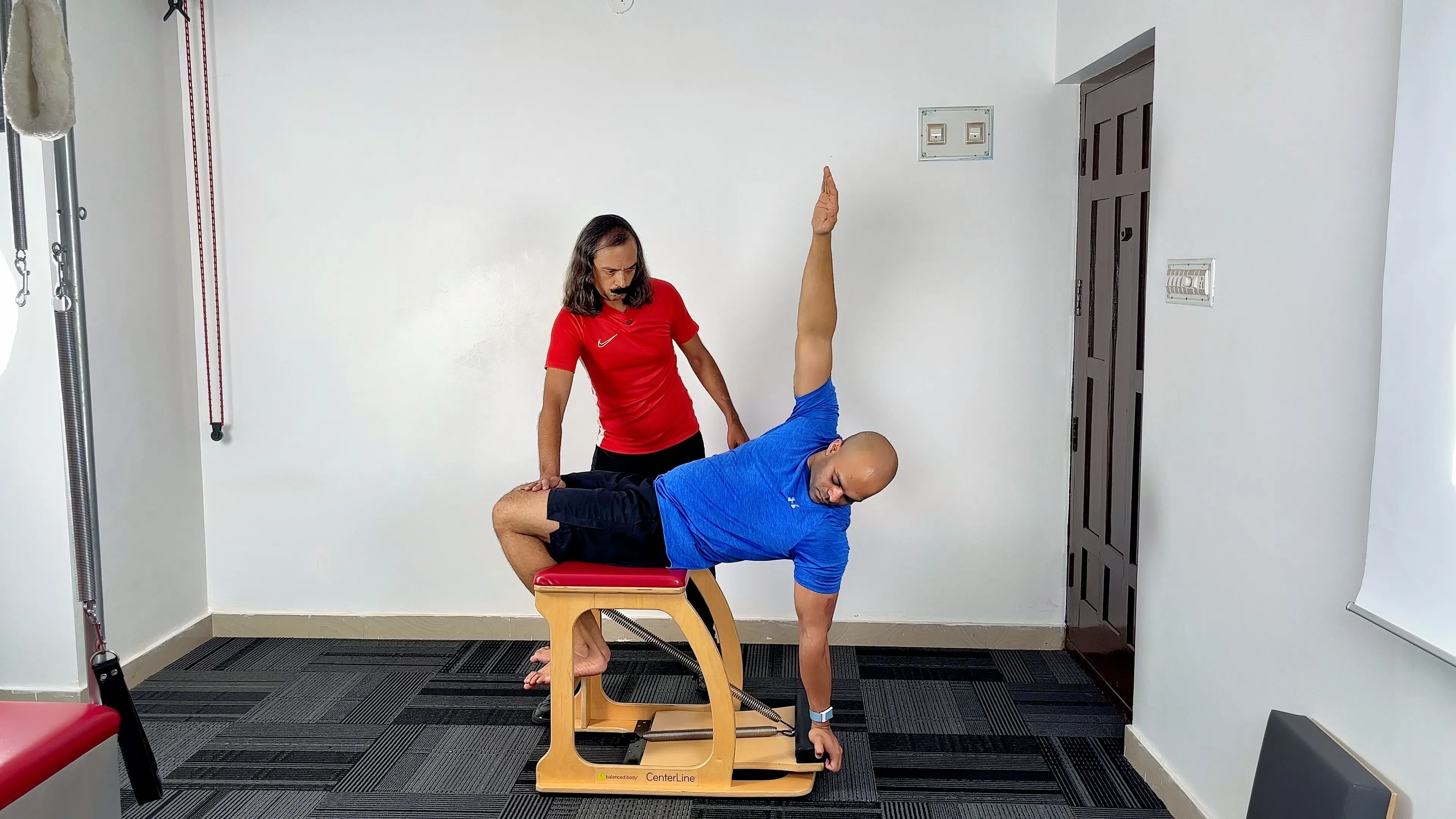
In many exercises, I look at both what is moving and what is stabilising. The question is not only where the body is going, but what is organising the movement in the opposite direction. In the Twist of Stomach Massage, the rotation happens against the stabilisation of the opposite side. In Elephant, working against rather than with the springs creates the demand the exercise is designed to produce. In the way I was taught, stretch is dynamic and two-directional, organised through opposition. Where that opposition is, what provides it, and how the body organises itself against it gives an instructor a road map for what to cue and how to refine each exercise.
How the Method Is Taught Here
Pilates is frequently described as a core-building exercise, a posture correction programme, or a method for curing back pain. Each of these descriptions contains a partial truth and a significant distortion.
The core is not treated here as the stomach alone. It includes the coordinated work of the trunk, pelvis and hips, including the spinal extensors, rather than the isolated contraction of the abdominal wall.
This studio does not present Pilates as a cure for medical conditions. The method is taught here as structured work with movement, alignment, coordination, breath and control. It is movement education, not diagnosis, treatment or rehabilitation.
What I Understand as Distinctive in the Method
The distinction I find most useful is not fully captured by the six principles. It lies in the more specific organisation of the exercises, apparatus and sequence.
As far as I understand and teach the method, one of Pilates' distinctive features is that stretching and strengthening are often present simultaneously — not as separate phases, but as a coordinated action within the work. You are not simply holding a posture to stretch and then performing repetitions to strengthen. The relationship between length and effort is built into the exercises.
This is possible because of how the method uses what might be described as a strong centre with dynamic two-way stretch — opposition forces working through the body simultaneously, with controlled spinal positions that integrate flexion, extension, and rotation into coherent movement patterns rather than isolating them.
I do not treat engagement of the centre and the position of the spine as separate considerations. They are organised together rather than as sequential actions. That integration is part of what the method trains.
The Apparatus and the System
Consider the exercise called Teaser. Versions can be performed on the Reformer, Cadillac, Wunda Chair, Spine Corrector and Mat. Each version changes the surface, spring relationship, support and balance demands. The exercise name may remain the same, but the conditions under which the body organises it change.
This is what the complete apparatus system is for — not variety for its own sake, but a carefully constructed environment in which the same movement qualities can be practised from multiple angles and at multiple levels of demand.
The Method Has a Foundation
The Pilates method has an internal logic that helps me assess progression. In the sequence I use, steadiness through Leg Circles and Frog is one of the signs I look for before introducing Short Spine. I observe whether the foot remains consistent in the strap while the leg moves and whether the pelvis and trunk can remain organised.
That control is not the only consideration, but it provides useful information about readiness. The sequence is therefore part of how the work is assessed and progressed.
The method gives the teacher many of the clues needed to progress a client from one exercise to the next. The sequence itself is part of the curriculum.
The Principles Are Present From the Beginning
Here is what is worth understanding about the six principles: you do not need to wait for a particular exercise or stage of training to begin applying them. Centering, control, concentration, precision, breath, fluidity — all of these are present and required from the very first exercise in the very first session.
They are not milestones. They are the quality of attention brought to the work at every stage. A beginner working on basic Footwork is already being asked to centre, to breathe, and to work with precision. An advanced practitioner doing Snake is working with the same qualities at a higher level of demand.
The principles describe how the method is practised, not what distinguishes it from other methods. The distinction lies in the architecture — the apparatus, the sequencing, the integration of stretching and strengthening, the relationship between the centre and the spine, and the deliberate logic that links every exercise to every other.
That is the architecture I am trying to understand and preserve. Seeing the method at that level changes how it is taught — and how it is experienced.