Seven Years Into Teaching
Written by Abdul Kalam, Pilates instructor · For educational purposes only; not medical advice.
The first session I ever took as an instructor was not a private. It was a corporate community class — a large group, mat work, assigned to me immediately after completing my training. I don't remember the exact count but the room was full. I was nervous in a way I have not been since. By the time it ended I knew two things: that I could do this, and that I wanted to do it differently.
For the first six months after that I taught mainly privates. The clients varied — some healthy, some working around injuries, some trying to correct imbalances, some simply wanting to move better. The work was one body, one session, full attention. I understood what I was being asked to do and I could do it properly.
Then the studio introduced group classes and I began teaching those too. The maximum in any group was four people. Four is not many. But even four distributed the attention in a way that changed the work fundamentally. What served one body well did not serve another equally. Every decision became a compromise — a balancing act to ensure everyone received a fair level of work rather than the right level of work. The teaching was enjoyable. It did not give me the same satisfaction as a private.
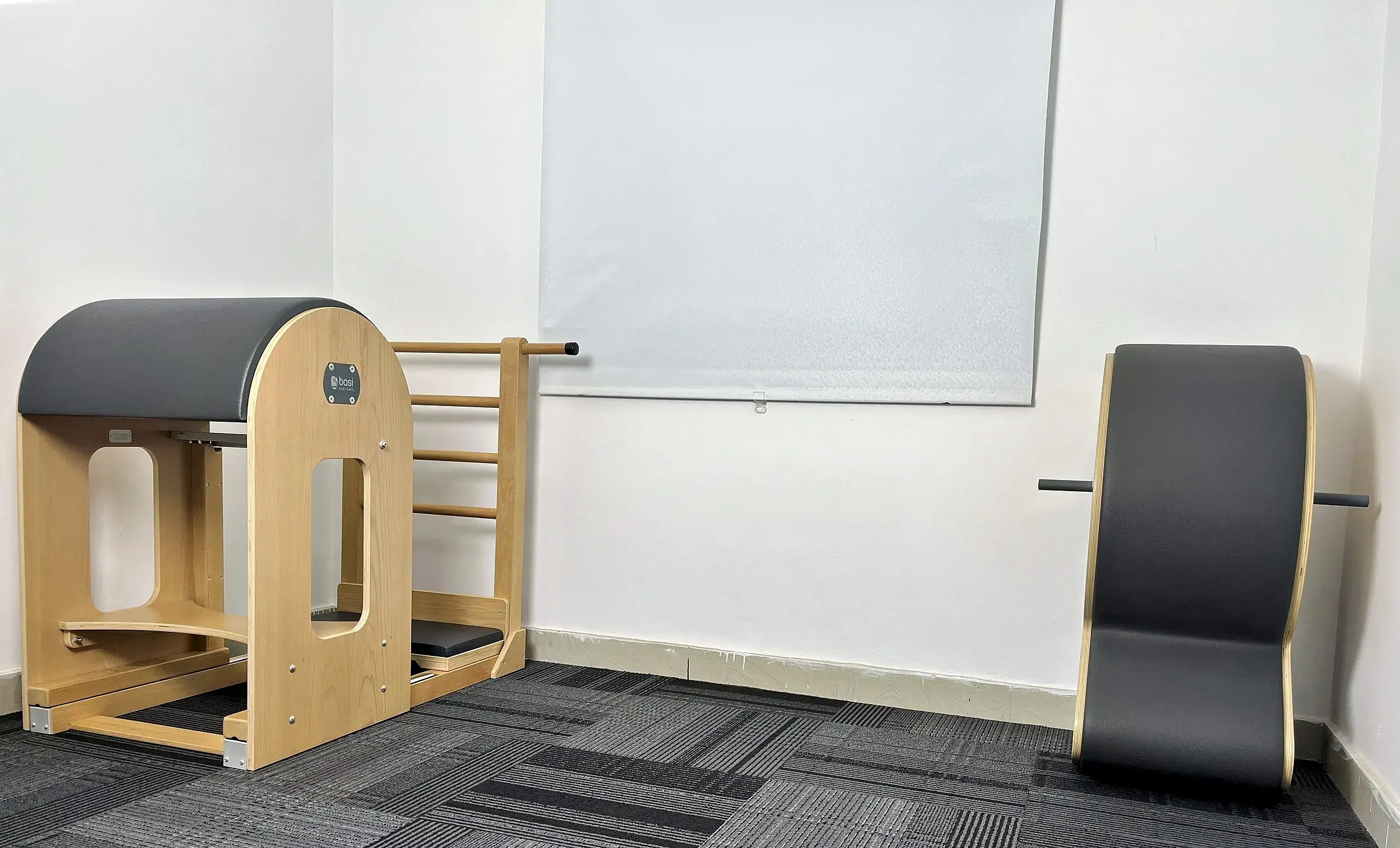
I continued that way until 2021. By then the comparison had become impossible to ignore. Private instruction was where the work was actually happening. Group teaching was something else — useful, perhaps necessary for some people, but not the thing I was trying to do. In 2021 I made the decision: private only, one client at a time, the full apparatus system rather than a single machine. Not a reformer studio. The complete ecosystem Joseph Pilates designed, one piece of each.
That decision has not changed and will not.
What has changed is how I teach within it.
When I started, I had a framework from my training — a choreography, a fixed sequence, a plan for each session. I ran the body through it. The cues were accurate, the exercises were correct, the work was delivered as I had been taught to deliver it. That was as it should be at the beginning.
Over time the choreography became less fixed. I started adapting the same exercises more precisely to the body in front of me — same programme, more refined cues. The script loosened but it was still there.
Then the script disappeared.
At some point I stopped arriving at sessions with a plan. Not because I became careless — because I became more capable. I had absorbed the system thoroughly enough that I could read what a body needed on a particular day and select from the full apparatus accordingly. The question stopped being which exercises am I going to teach today and became what does this body need right now, and which part of the system addresses that most directly. The entire apparatus ecosystem became a vocabulary I could draw from rather than a menu I moved through in order.
That shift is what seven years of teaching produced. Not a philosophy. A capacity.
I am more self-assured now than I was in 2018 — not because teaching has become easier but because I no longer need the script to feel confident. The method is what it is. Joseph Pilates' work is not negotiable and I have no interest in negotiating it. But how I bring it to a specific body on a specific day — that is mine, developed through repetition and attention over years. My teaching is recognisably my teaching. That did not come from training. It came from the work itself, session after session, until it settled into something I can trust.
I am not trying to scale this. I am not trying to compete. I teach a small number of people privately, on equipment that covers the full system, for as long as the working relationship serves them. That is what I decided in 2021 and it is what I will continue doing.
Seven years in, that is enough. It is more than enough.