The Repetition Question
Written by Abdul Kalam, Pilates instructor · For educational purposes only; not medical advice.
At some point, most long-term clients ask a version of the same question: why do we keep returning to the same exercises?
Every session starts with Footwork. The Hundred follows. That order is part of the original sequence I teach, whether the session begins on the Reformer or through the corresponding Mat work. The broader arc of the work also remains recognisable from one session to the next.
The repetition is deliberate. It is not repetition for volume or an attempt to fill time. It gives the client and instructor another opportunity to work with a familiar demand under the conditions present that day.
Repeated Practice and Learning
When a movement is practised repeatedly with attention, the client has more opportunities to understand the setup, coordinate the movement, respond to feedback, and notice what changes under different conditions. Something that begins as effortful and unfamiliar may become more organised over time.
Repetition is only one part of that process. Instruction, feedback, rest, variation, the client’s previous experience, and the way practice is structured also matter. Repeating an exercise without attention does not automatically make it clearer. The value lies in returning to it with enough awareness to observe and refine what is happening.
Footwork as a Familiar Pattern
Reformer Footwork can appear simple from outside: the client lies on the carriage, places the feet on the bar, and opens and closes the carriage against spring resistance.
The exercise shares some lower-limb actions with movements such as sitting down and standing up. The hips, knees, and ankles flex and extend in coordination. The comparison can help explain why Footwork is not concerned only with moving the carriage.
It is not identical to a standing squat or to climbing stairs. The body is supported, balance demands are different, gravity acts in a different orientation, and the springs alter the resistance. The relationship is useful as a movement comparison, not as a claim that practising one task automatically changes performance in another.
Because the exercise is familiar and supported, I can observe details such as how the feet meet the bar, how the knees travel, how the pelvis and ribcage remain organised, how the carriage returns, and whether the client is holding their breath. Those observations may lead to different cues on different days.
The Roll-Up: One Example of Progression
The Roll-Up is another exercise that benefits from repeated exposure. Some clients can work with the full exercise early. Others need a more supported starting point.
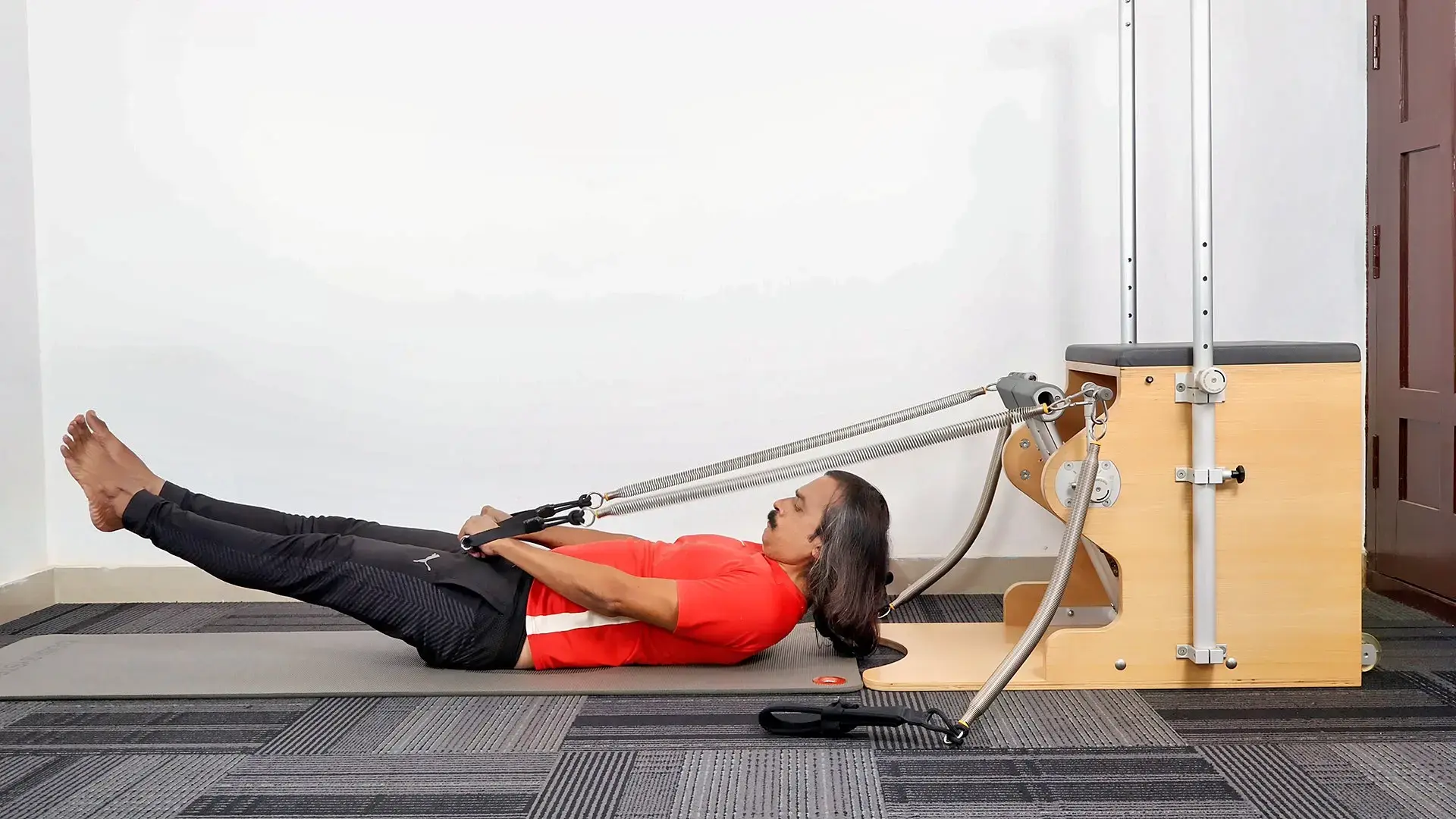
One progression I may use begins seated with the knees bent and the hands supporting the thighs. The client practises controlling a small backward movement and returning to sitting. As the movement becomes more familiar, the range or support can change. A different client may require a different preparation, apparatus, or sequence.
I revisit a variation while it remains useful, then change the setup when the client appears ready for another demand. There is no requirement that every client reach the same version, and there is no fixed number of sessions attached to the progression.
Repetition as Refinement
Once an exercise is familiar, repeating it does not mean repeating an identical lesson. On one day I may direct attention toward the timing of the breath. On another, the sequencing of spinal movement. On another, the relationship between the pelvis and trunk, the reach of the legs, or the organisation of the head and neck.
The exercise provides a stable reference. What changes is the information available to the client and the aspect of the movement receiving attention. Familiarity makes refinement possible because less of the session is spent explaining the basic shape.
Related Work Across the Apparatus
Related versions of familiar movement patterns appear across the Pilates apparatus. Teaser work, for example, can be encountered on the Mat, Reformer, Cadillac, and Wunda Chair. Each version changes the relationship between the body, gravity, support, resistance, and the moving parts of the apparatus.
These versions are not mechanically identical, and I do not treat them as interchangeable. Working with related patterns under different conditions can, however, help a client recognise how the system connects. Something learned in one setup may provide useful context when a related demand appears elsewhere.
What Repetition Means Across Years
After several years, a client may have encountered foundational exercises many times, through periods of confidence, fatigue, interruption, return, and changing circumstances. The exercises remain recognisable, but the client’s relationship to them is not static.
The instructor also has a longer record. A familiar exercise can show how the client moves today in relation to previous sessions without turning the comparison into a promise of constant improvement.
This is why novelty is not the measure of a useful session. New exercises have a place, but so does returning to the work that has been there from the beginning.
The repetition is not there because nothing has changed. It is there because a familiar exercise gives us another place to observe what has.