Joseph Pilates: The Man Behind the Method
Written by Abdul Kalam, Pilates instructor · For educational purposes only; not medical advice.
Joseph Hubertus Pilates was born in 1883 in Mönchengladbach, Germany. He died in New York in 1967 at the age of eighty-three. In the eight decades between, he developed a system of physical training that was largely overlooked during his lifetime and has become one of the most widely practiced movement disciplines in the world since his death.
Understanding who Pilates was — his background, his influences, the context in which he worked — provides useful perspective on the method he created and why it takes the form it does.
Early Life and Physical Development
By his own account, Joseph Pilates was a sickly child — afflicted with rickets, asthma, and rheumatic fever. Whether this was entirely accurate or somewhat embellished in the telling, his response to physical weakness was consistent with everything that followed: he studied the body systematically and worked to develop it deliberately.
As a young man he became proficient in gymnastics, diving, skiing, and boxing. He studied anatomy, observed animals in motion, and developed an early understanding of how the body could be trained to move with greater efficiency and control. These early interests — movement mechanics, systematic training, the relationship between physical and mental discipline — remained central to his work throughout his life.
The First World War and the Development of the Method
When the First World War began, Pilates was living in England and was interned as an enemy alien. During his internment, first on the Isle of Lancaster and later on the Isle of Man, he began working with fellow internees and later with hospital patients — developing and refining the exercises that would become his method.
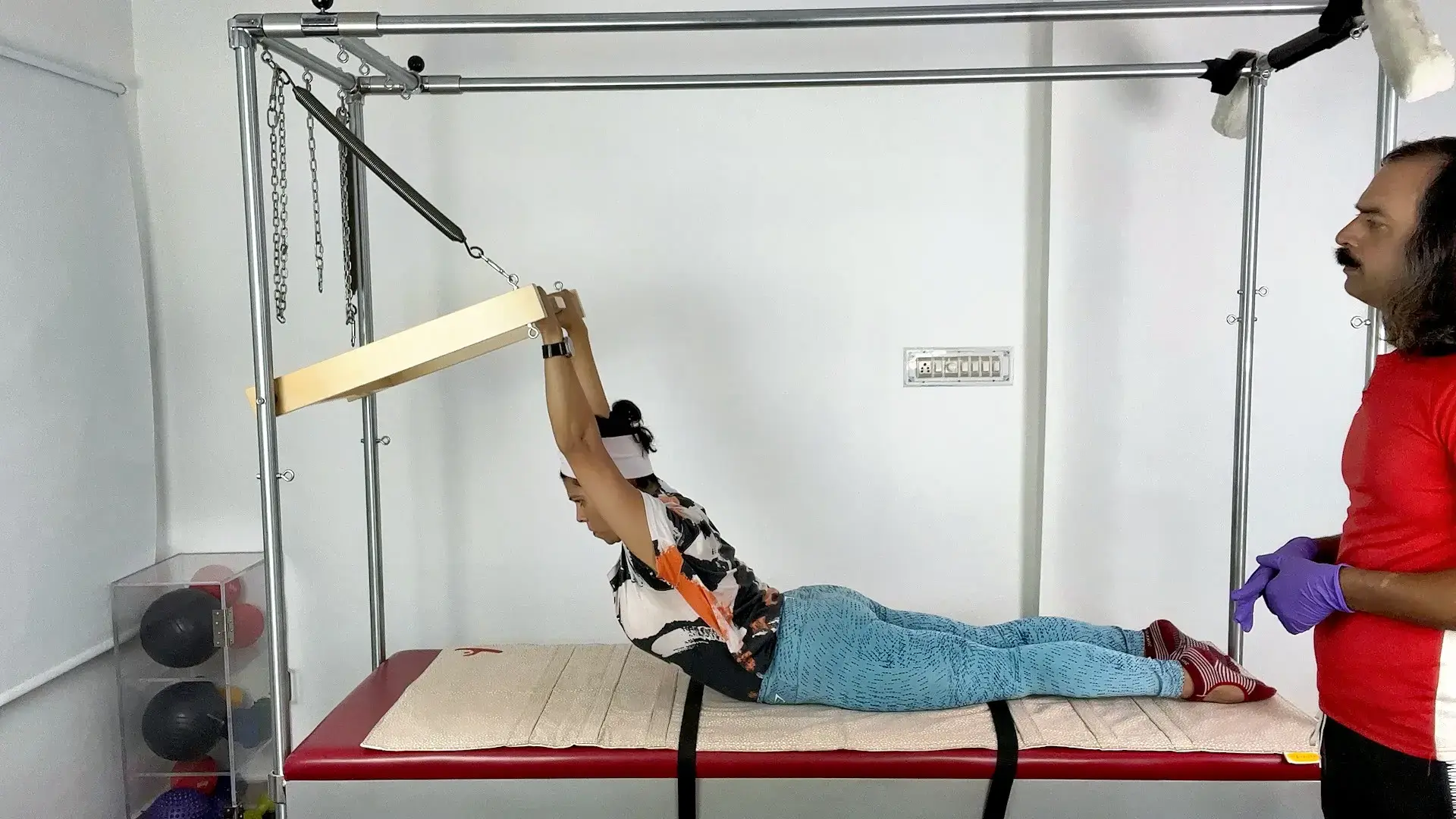
It was during this period that he developed the apparatus. Working with bedridden patients, he attached springs to hospital beds to allow resistance-based exercise for those who could not stand or move freely. The Cadillac — the large frame apparatus central to the classical studio — is a direct descendant of this improvised rehabilitation work.
The circumstances of wartime internment shaped the method in a specific way. The exercises had to work for people in varying states of physical capacity. They had to be adaptable. They had to produce results without requiring access to conventional training facilities. These constraints produced a system that remains remarkably adaptable across a wide range of physical conditions and capacity levels.
New York and the Studio Years
After the war, Pilates emigrated to the United States, arriving in New York in the early 1920s. He established a studio at 939 Eighth Avenue, in the same building as several dance rehearsal spaces. His proximity to the New York dance community was not incidental — many of his early clients were dancers, and the physical demands of professional dance aligned closely with what his method was designed to develop.
George Balanchine and Martha Graham both sent students and company members to Pilates. His reputation grew within the dance world, though he remained largely unknown outside it. The method he taught was called Contrology — a name that captured his emphasis on conscious, coordinated control of the body. The name Pilates was applied by others after his death.
He ran the studio until his death in 1967. Clara Pilates, his wife and long-time collaborator, continued to teach there for several years afterward. The students who trained with him directly — Romana Kryzanowska, Kathy Grant, Ron Fletcher, Carola Trier, and others — became the first-generation teachers who transmitted the method after his death.
What He Left Behind
Joseph Pilates published two books during his lifetime. Your Health, published in 1934, outlined his philosophy of physical education. Return to Life Through Contrology, published in 1945, presented the mat exercise sequence with photographs and commentary.
Beyond these texts, the method survived through the people he taught. The transmission was direct and personal — observation, correction, repetition under supervision. This is why lineage matters in classical Pilates training: the method was never fully codified in written form, and the subtleties of how it is taught are carried in practice rather than in documentation.
Joseph Pilates was not recognised as a significant figure in physical education during his own lifetime. His work existed at the margins of the mainstream fitness world. The scale of the method's spread since his death would likely have surprised him — and the degree to which the name Pilates has been applied to work that bears little resemblance to what he taught might have concerned him more.
The man and the method are best understood together. What Pilates developed was inseparable from who he was — systematic, disciplined, and convinced that the body, properly trained, was capable of far more than most people allowed it to become.