The Architecture of Movement: Why Sequence Matters in the Pilates Method
Written by Abdul Kalam, Pilates instructor · For educational purposes only; not medical advice.
In the original Pilates method — historically referred to as Contrology — the order of exercises is never random. Each movement exists within a carefully constructed sequence designed by Joseph Pilates himself. The exercises build upon one another, preparing the body step by step for increasingly complex challenges. Rather than a collection of unrelated movements, a Pilates session unfolds as a deliberate progression that warms the body, deepens coordination, and gradually restores efficient movement patterns.
Understanding the Logic of Sequencing
To appreciate the importance of sequence, it helps to understand the larger goal of the Pilates method. The system is intended to be a complete physical and mental practice, adapted to the individual performing it. Each session should challenge the practitioner across multiple dimensions — stamina, strength, mobility, stability, and coordination working together rather than in isolation.
For healthy individuals, the work gradually builds toward greater physical demand. For those with injuries or special considerations, the sequence may be adjusted to respect their condition. Even when modified, however, the underlying principle remains the same: each exercise prepares the body for the next. As the body learns one movement, it develops the awareness and strength required for the following one.
Sequencing on the Reformer
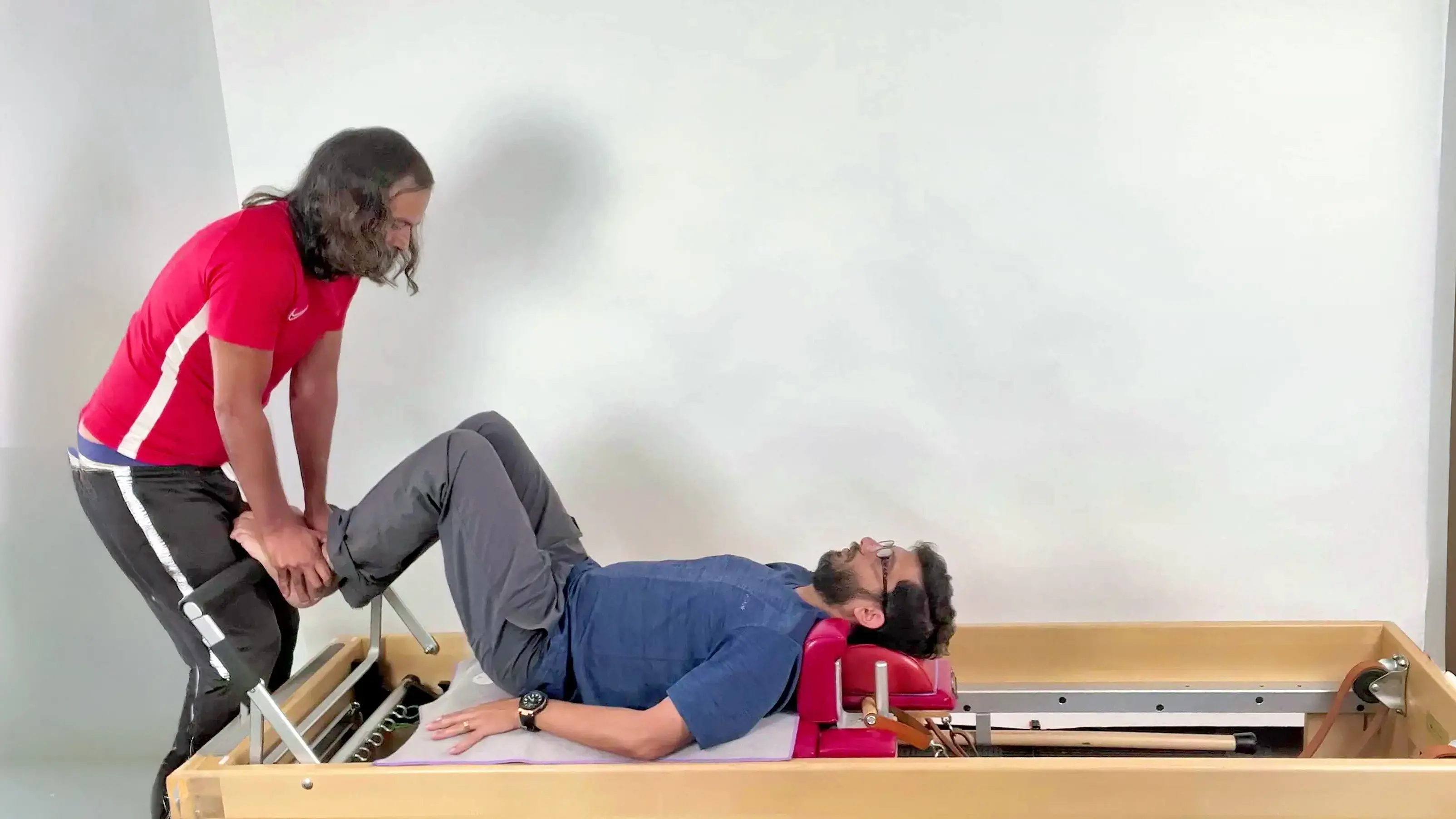
The Reformer repertoire provides a clear example of this progressive logic. A traditional introductory sequence often begins with Footwork — these movements warm the body while helping establish alignment through the feet, knees, hips, and spine. Once the lower body is prepared, the session transitions into exercises such as The Hundred, which introduces stronger breathing patterns and upper-body engagement.
Exercises like Leg Circles and Frog challenge the practitioner to stabilize the body from the center as the legs move freely in space. From there, the sequence moves into seated work such as Stomach Massage, which builds upon the principles learned in Footwork while requiring greater core engagement and balance. The Short Box series continues to strengthen the center while introducing spinal flexion, extension, and rotation. Later exercises such as Knee Stretches deepen the connection between the legs and the center of the body, encouraging mobility from the hip joints.
Toward the end of the sequence, movements like Running and Pelvic Lift refine coordination and hip stability while gradually returning the body toward a calmer state. In this way, the workout evolves continuously — each exercise expanding upon what the body has just learned.
Why Footwork Begins the Reformer Session
In most Reformer sessions, Footwork serves as the gateway into the workout. The feet are fundamental to human movement. Whether we walk, stand, or squat, our relationship with the ground begins through the feet. Footwork allows the practitioner to begin moving under the support of the apparatus while establishing proper alignment throughout the body. It warms the muscles, mobilizes the joints, and introduces the coordinated pushing action that will appear throughout the rest of the workout.
Recognising Patterns in the System
Another remarkable aspect of the Pilates method is the repetition of movement patterns across different exercises. Many movements share the same fundamental mechanics but are performed in different positions or against different forms of resistance. The Hundred and Elephant, for example, both challenge the connection between the limbs and the center of the body — but in different orientations to gravity. Footwork and Stomach Massage share similar pushing mechanics, yet the latter demands greater core control in a seated position.
By repeating patterns in new contexts, the system reinforces learning within the nervous system. The body begins to recognise these relationships and develops more efficient coordination.
What Happens When the Sequence Is Changed
It is certainly possible to modify the order of exercises when working with individual needs or limitations. However, abandoning the sequence entirely removes much of the intelligence built into the system. The original order was designed to guide the body through a specific learning process. When exercises are rearranged without that logic, the body may not receive the same neurological and mechanical benefits.
Joseph Pilates emphasized throughout his writing that the method is not merely a collection of exercises but a carefully constructed system of movement education — one in which precision and sequence are inseparable from the results it produces.
Trusting the Architecture of the Method
Joseph Pilates designed his sequence with remarkable intention. Each exercise prepares the body for the next, gradually increasing strength, flexibility, and control. The structure resembles a carefully composed narrative: beginning with preparation, progressing toward challenge, and concluding with integration. By following this architecture, the practitioner experiences a balanced workout in which every part of the body participates.
When the sequence is respected, the body responds with greater efficiency, resilience, and awareness.