How the Studio Came Together
Written by Abdul Kalam, Pilates instructor · For educational purposes only; not medical advice.
The equipment in this studio was not planned or purchased all at once. It was assembled over several years, piece by piece, as my teaching developed and the practical requirements of the work became clearer.
The result is not a collection built for display. Each apparatus is present because it provides a particular arrangement of support, resistance, position, or feedback that I use in private instruction.
The First Purchase
The first piece I bought was a Balanced Body CenterLine Wunda Chair in November 2020. Studios were closed during the COVID period, I needed apparatus that could be used at home, and the CenterLine equipment was familiar from my initial training and teaching.
The Chair was compact, movable, and practical for the space available at the time. It gave me a way to continue practising and to work with spring resistance without trying to recreate a full studio at home.
Adding the Reformer
When the studio opened, a Balanced Body CenterLine Reformer came next. Familiarity again mattered. I already understood its basic setup, spring system, straps, carriage, and adjustment points. Beginning with known equipment allowed my attention to remain on teaching rather than on learning an unfamiliar apparatus while the studio itself was new.
The Reformer remains in regular use. It provides a moving carriage, spring resistance, straps, a footbar, and several positions from which the body can be observed and taught. It is important within the studio, but it is not treated as the entire method.
Why More Apparatus Was Added
As the client base became more varied, I needed additional dimensions, spring arrangements, and working positions. One apparatus does not suit every exercise or every person equally well. A movement that is unclear on the Reformer may become more accessible on a Chair, Cadillac, Barrel, or another piece because the relationship to gravity, support, and resistance changes.
This was the main reason the studio expanded. The additions were not intended to create novelty from session to session. They gave me more ways to teach the same underlying movement qualities under different conditions.
The F2 Wunda Chair
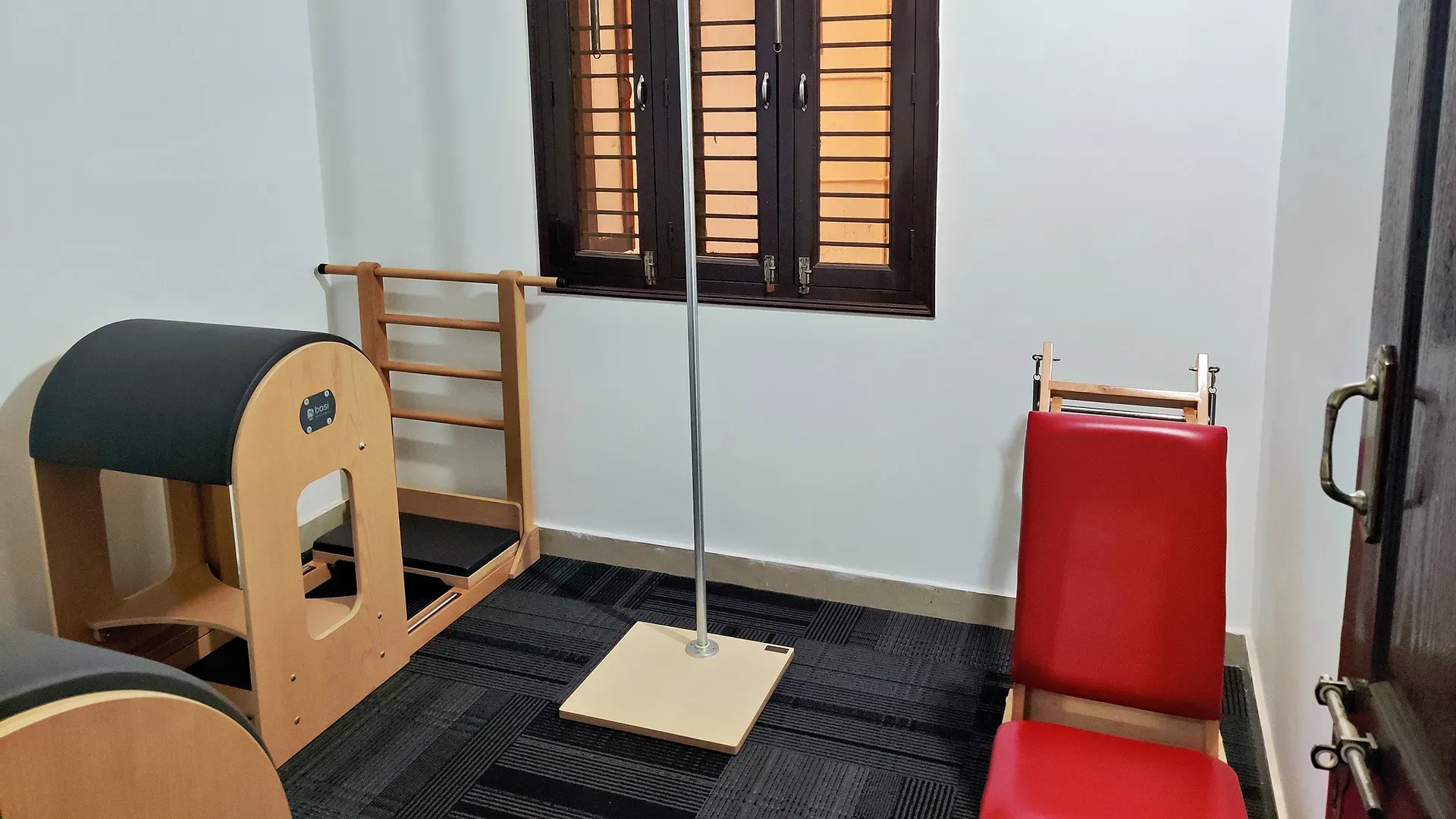
I later added a BASI Systems F2 Wunda Chair. Its dimensions and adjustment options gave the studio another Chair configuration, and the F2 attachments allowed springs to be used from the sides in selected exercises.
That makes it possible, where appropriate, to combine the work of the arms and legs within one setup. It is not automatically better or more advanced than the first Chair. It is another tool, and its value depends on the exercise, the person, and the reason for choosing it.
The F2 Spine Corrector and Ladder Barrel
The F2 Spine Corrector and Ladder Barrel were added during the same stage of the studio’s development. The Spine Corrector provides a shaped surface for working with spinal flexion, extension, support, and positioning. The F2 attachments also allow springs to be incorporated into some exercises.
The Ladder Barrel provides a different relationship between the body, the curved barrel, and the ladder. Its adjustable distance is useful when working with people of different proportions and when changing the setup between clients.
Neither piece replaces the Reformer or Chair. They change the conditions under which movement is organised and give me another view of what a client is doing.
The Cadillac
The Cadillac was the next major addition. I considered equipment from more than one manufacturer and eventually chose a Legacy Cadillac. Availability, shipping, cost, dimensions, and the practical requirements of the studio all formed part of the decision.
The Cadillac is now one of the most frequently used pieces in the studio. Its raised mat, overhead frame, bars, straps, and springs allow work in lying, seated, kneeling, standing, supported, and suspended positions. It can provide assistance in one exercise and create a greater demand in another.
For private teaching, that range is useful. It gives me options when floor work is not appropriate, when a client needs more support, or when the direction of resistance needs to change.
The Wall Unit
A Legacy Wall Unit was purchased while I was considering how the available space might be used more fully. At one stage, I also considered whether semi-private teaching would become part of the studio. I ultimately decided to retain the one-client format.
The Wall Unit remained useful. It is used for standing arm-spring work, selected Mat exercises, and situations where a fixed vertical spring arrangement is more practical than using the Cadillac. An apparatus does not have to be used for its original purchasing idea in order to have a continuing role.
Ped-o-Pul and Baby Chair
The Ped-o-Pul and Baby Chair were added later. Both occupy little floor space, but each creates a specific teaching environment.
The Ped-o-Pul is used for standing work involving alignment, balance, spring resistance, and control. The Baby Chair provides a seated or supported arrangement that can be useful when working with foundational organisation, upper-body support, and spinal movement.
They are not used in every session. Their purpose is to be available when their particular setup gives a clearer way to teach what is needed.
The Smaller Apparatus
The studio also contains smaller apparatus, including the Foot Corrector, Toe Corrector, Bean Bag, Neck Stretcher, head cushions, neck pillows, Posture and Poise device, 2×4 board, Kuna Board, and aeroplane boards.
Because these pieces are small, they can appear secondary beside a Reformer or Cadillac. In practice, a small apparatus may isolate a particular relationship of the foot, hand, neck, shoulder, or standing position more clearly than a larger piece can. They are used selectively rather than as accessories added for variety.
The Studio as It Stands Now
The current studio contains apparatus from several manufacturers and from different design traditions. I do not require every piece to feel or operate identically. I need to understand the equipment in front of me, maintain it correctly, respect its specifications, and choose it for a clear reason.
Not every client uses every apparatus, and no session is designed to demonstrate the inventory. The equipment exists to give the teaching enough range to remain individual without abandoning the structure of the method.
The studio was assembled gradually. Each addition created another practical way to support, challenge, or observe movement within private instruction.