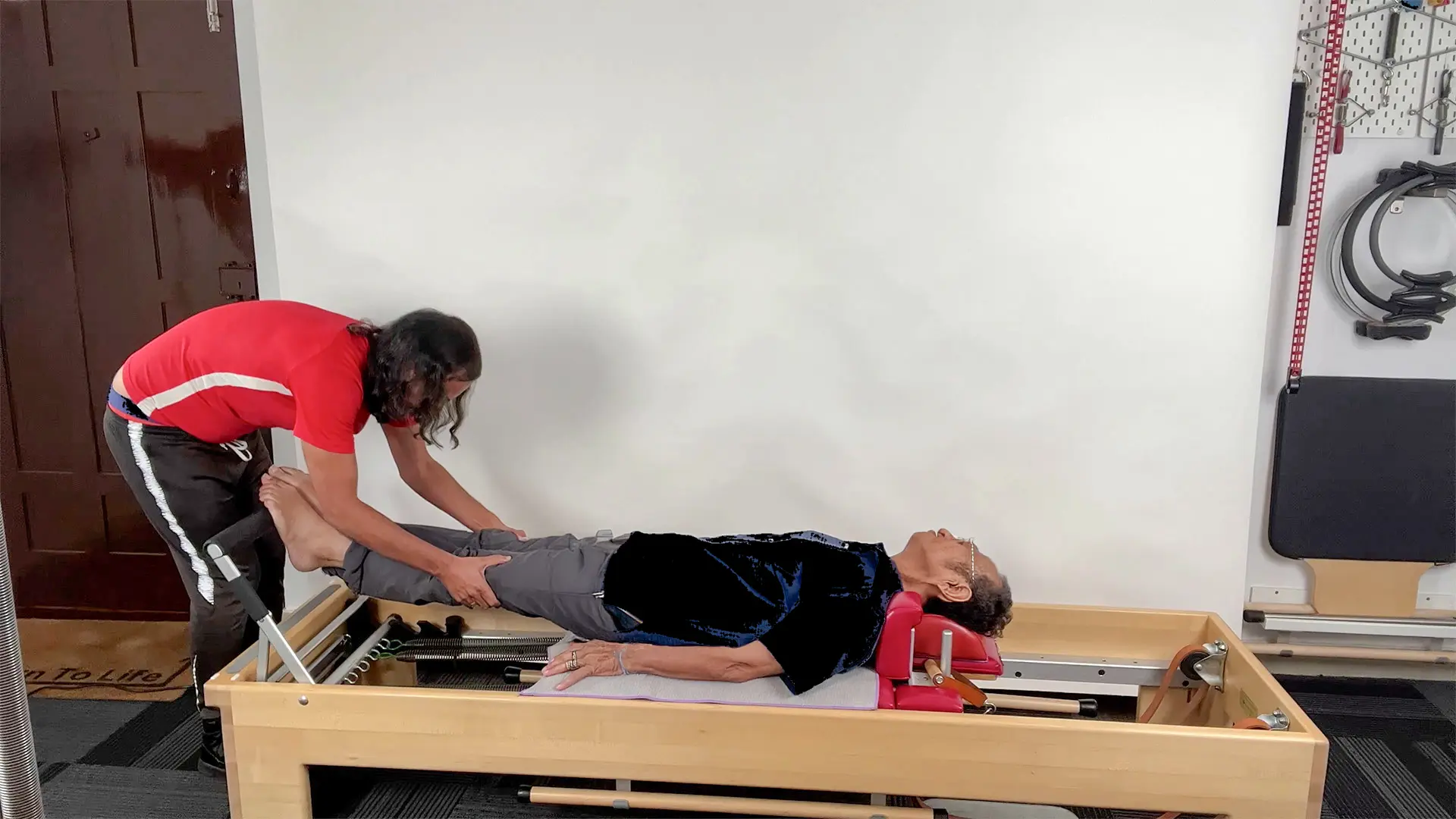
How I Work With Older Clients
Written by Abdul Kalam, Pilates instructor · For educational purposes only; not medical advice. Medical suitability and treatment remain with qualified healthcare professionals.
Older clients are not one uniform group. A person in their sixties who has remained physically active may arrive with very different capacities and concerns from another person of the same age who has had recent surgery, a long period of inactivity or a complex medical history.
I therefore do not use age alone to decide what a client should or should not do. The work begins with the individual: their stated goals, relevant medical information, current movement experience, comfort with the studio and what can be observed safely within my scope as a Pilates instructor.
Access to the Studio
The studio is on the second floor and there is no lift. Reaching it requires climbing approximately forty-five stairs.
A prospective client must be able to reach and leave the studio safely. Managing the stairs on one occasion is not a cardiovascular test, medical assessment or proof that Pilates instruction is suitable. It is simply an access requirement of this particular premises.
Where the stairs are unsafe, excessively difficult or incompatible with a person’s medical guidance, a more accessible setting may be appropriate.
Before Lessons Begin
The intake and consultation are used to understand relevant history, current symptoms, recent procedures, medication considerations disclosed by the client, previous movement experience and any guidance already provided by a healthcare professional.
I do not diagnose a condition from posture or movement. I also do not assume that a particular change is present simply because of age.
Where a medical history, current symptom, recent surgery, instability or existing clinical instruction makes clearance appropriate, I ask the client to consult the relevant healthcare professional before beginning or continuing. Written guidance is useful where it defines precautions or limits that affect movement instruction.
How I Choose a Starting Point
The first sessions are used to establish how the client manages basic positions, transitions, spring resistance, changes of direction and the practical use of the apparatus.
I may begin with a stable, supported setup where the client can concentrate on the movement without also managing a moving surface or a demanding transition. For some clients that may be the Cadillac or a seated apparatus. For others, the Reformer or Mat may be entirely appropriate from the beginning.
No apparatus is automatically suitable or unsuitable because a client is older. Selection depends on the exercise, the individual, access to the equipment, the manufacturer-approved setup and what I can supervise responsibly.
Adapting Within the Method
An exercise can often be introduced through a different range, position, resistance, tempo or apparatus. I may bend the knees instead of keeping the legs straight, reduce the range of spinal movement, use a more supported starting position or select a preparatory exercise.
These decisions are not made from age alone. They are responses to what the client reports and what can be observed in that session.
There are also situations in which the appropriate decision is not to use a particular exercise. Remaining within the Pilates repertoire does not require forcing every client through every movement.
Strength, Mobility and Daily Function
Older clients come with different priorities. Some want to maintain strength. Some want greater confidence with ordinary movement. Others are looking for a structured practice that complements medical care or another form of activity.
Within the studio, I may work with controlled resistance, movement through a comfortable range, balance under appropriately supported conditions, coordination and transitions such as getting up from a seated position.
These are areas of movement practice, not promised outcomes. Improvement varies, and Pilates does not replace assessment or treatment for pain, falls, neurological symptoms, cardiovascular concerns, osteoporosis, joint replacement or any other medical condition.
Spring Selection
I do not choose a spring setting solely because a client belongs to an age group. Lighter is not automatically safer, and heavier is not automatically more effective.
The effect of a spring depends on the apparatus, exercise, direction of movement, body position and individual using it. I select settings within the equipment manufacturer’s specifications and adjust them according to the movement being taught and the client’s response.
Spring counts are not meaningful across all manufacturers or machines, so I do not present a particular number as a general rule for older clients.
Pace and Communication
People differ in how much information they can use while moving. That variation exists at every age and can also change from one day to another.
I generally begin with one clear task at a time and add information only when it can be used. I may slow the pace, repeat an instruction, allow more time for a transition or reduce the number of changes within a sequence.
This is not based on an assumption that an older client cannot understand complex information. It is a teaching decision based on the person in front of me and the demands of the movement.
Touch and Consent
Hands-on cueing may be offered when it could provide a useful physical reference. I explain the proposed contact, its location and purpose, and ask for the client’s permission before touching.
Touch may be declined or withdrawn at any time. Where touch is not wanted, I use verbal instruction, a demonstration, a different setup or another exercise.
Variation From Session to Session
A client may arrive feeling different from the previous lesson. They may report fatigue, discomfort, poor sleep, a change in medication, a recent medical appointment or simply a lower level of confidence that day.
I do not infer the cause from appearance alone. I ask relevant questions and adjust only within my professional scope. Depending on the information provided, the session may be modified, postponed or referred back to a healthcare professional.
When This Studio Is Not the Right Setting
This studio may not be appropriate where:
- the stairs cannot be managed safely;
- the client requires clinical rehabilitation or monitoring that I do not provide;
- medical clearance or relevant guidance has not been obtained where needed;
- the available apparatus or physical environment cannot accommodate the client safely;
- the client’s needs fall outside my training or professional scope.
Declining or pausing instruction in those circumstances is not a judgement about the person’s ability to benefit from movement. It is recognition of the limits of this particular studio and service.
What I Am Offering
I offer private Pilates instruction adapted to the individual, with attention to access, current capacity, communication, consent and relevant medical boundaries.
I do not offer a standard senior programme, medical treatment or a guarantee that a particular functional change will occur. The aim is to provide structured movement education at a level and pace that can be taught responsibly in this setting.
An older client is not defined by age alone. The starting point is the individual, the information they provide, the movement that can be observed safely and the limits of the studio’s scope.