Pilates apparatus at a private studio in Bengaluru — Cadillac and Reformer maintained and ready

How I Maintain the Equipment in My Pilates Studio

Written by Abdul Kalam, Pilates instructor · For educational purposes only; not medical advice. Product references reflect my own studio practice based on manufacturer guidance — always consult your equipment manufacturer before using any product on your apparatus.

I come from an engineering background. I have always enjoyed working with machines — understanding how they function, what they need, and how to keep them running well. Pilates apparatus is no different. These are precision instruments, built to specific tolerances, under load every session. They deserve the same care and attention you would give any significant mechanical investment.

Think of it like a car. A car needs regular cleaning, periodic inspection, scheduled servicing, and occasional repairs. If you ignore any of these, performance degrades quietly — and eventually something fails at a moment when you cannot afford it to. The same is true of a Reformer, a Cadillac, a Wunda Chair. The investment is substantial. The maintenance is what protects it.

This post describes the maintenance routine I follow in my studio. I want to be clear before going further: the products I mention are ones I use based on specific guidance from my equipment manufacturers. I am writing about what I do in my own studio with my own apparatus — not making recommendations for anyone else's setup. Every manufacturer has their own recommendations, and what works for my equipment may not be appropriate for someone else's.

Daily Maintenance

There are three maintenance actions that happen every day, at different points in the day.

After every session: Every surface that has been in contact with a client — upholstery, footbar, straps, any part the body has touched — is wiped down with a mild soap solution using a microfibre cloth. I dilute two to three drops of a gentle hand soap in a litre of water, store it in a spray bottle, and use it consistently after every session. This keeps the equipment hygienically clean without introducing harsh chemicals that can degrade upholstery or leather over time.

Beginning of the day: Before the first session, after I have finished my own practice, I do a precursory safety check of the entire studio. This is a high-level walkthrough — pulling each piece of equipment, checking that all springs are correctly hooked and look intact, verifying that hooks and fastenings are in place, confirming nothing looks loose or unusual. This takes a few minutes. It is not a detailed inspection — that happens weekly — but it ensures that nothing has shifted overnight and that the equipment is safe to use before a client arrives.

End of the day: A full studio clean. Every surface, the floor, the equipment. Everything is restored to the condition it was in at the start of the day. The studio should look the same at close as it did at open.

Weekly Deep Inspection

Once a week I go through each piece of apparatus in detail. This is where the real maintenance work happens. I will use the Reformer as the primary example because it has the most components requiring attention.

Springs

The springs are the most critical and the most easily neglected component of the Reformer. The problem is structural: the springs sit underneath the carriage, which means they are hidden during normal use. It is easy to develop a habit of not inspecting them regularly — and that is where accidents begin.

Every week I flip the carriage and remove the springs for inspection. I check for kinks, breakages, deformities, and the beginnings of rust. I check for S-wave coils and severe coil displacement — both are signs that the spring's integrity is compromised. The important thing to understand is that a spring can look fine at the footbar end and have a significant anomaly under the carriage where it cannot be seen during normal use. Flipping the carriage and removing the springs is the only way to know.

If anything looks abnormal — replace immediately. Do not wait. A compromised spring under load is a safety risk. Most manufacturers also specify a replacement timeline regardless of visible condition, and I follow those timelines without exception.

For any rust that appears on springs or other metal components, I use the product my manufacturer has specifically recommended for this purpose — applied as directed and only where needed.

Wheels and Rails

The carriage wheels run along the rails, and over time this contact leaves black marks on the rail surface. The state of the rails is the simplest indicator of how well a Reformer has been maintained. Too many black marks means the rails have been neglected. I clean the rails regularly using aluminium foil rubbed along the length of the rail — it removes the marks effectively without damaging the surface. A damp cloth works for lighter residue.

Beyond the marks, debris accumulates on the rails — dust, and occasionally hair caught between the wheels. Both need to be removed regularly. Hair in the wheels affects how the carriage runs and can cause uneven movement that the client feels during exercises.

On a classical Reformer, the wheels require greasing. I use the specific lubricant recommended by my manufacturer — a white lithium grease — applied regularly to keep the wheels running smoothly across the full length of the rails. The carriage should move without resistance or noise. If it does not, the wheels need attention.

Leather Straps

The leather straps are inspected for cuts, fraying, or any sign of structural weakness. Beyond the safety inspection, the leather needs conditioning to remain supple. Leather that is not conditioned dries out, stiffens, and eventually cracks. Every six months I condition the straps along their entire length using a leather care product — applied thoroughly and worked into the leather. This keeps them soft and extends their life significantly.

I also use saddle soap periodically to clean the leather before conditioning. This combination — cleaning followed by conditioning — is the most effective approach for maintaining leather that is used frequently and subjected to sweat and handling.

I do not use essential oils on the leather. They may seem like a natural alternative but they can dry the leather over time and cause cracking. I use products that are formulated specifically for leather care.

Upholstery

The upholstery is wiped down after every session as part of the daily routine. Beyond that, I do a deep shampoo of all upholstery once a year. This removes accumulated grime that surface wiping does not reach and keeps the material in good condition over the long term.

When the upholstery shows wear, cracking, or damage that surface cleaning cannot address, I contact the manufacturer directly. They supply replacement upholstery or direct me to someone who can carry out the work correctly for the specific apparatus.

Wooden Frames and Nuts and Bolts

In Bengaluru the weather produces significant contraction and expansion of wooden components across the seasons. This, combined with the vibration of regular use, causes nuts and bolts to loosen over time. This is not a sign of poor quality — it is simply the nature of wooden apparatus under real-world conditions. I check and tighten regularly using the appropriate tools.

Every week, as part of the deep inspection, I check all accessible nuts and bolts across every piece of apparatus. Anything that has loosened gets tightened. Anything that cannot be tightened to a secure position gets flagged for attention. A loose bolt in apparatus under load is not a minor issue — it is a safety concern.

The Cadillac

The Cadillac follows the same inspection logic as the Reformer — springs checked and removed for inspection, upholstery cleaned and maintained, wooden frame checked for loose hardware. The Cadillac has its own specific components that require attention.

The eyelets — the attachment points for the springs along the frame — need to be checked that they are firmly seated and have not worked loose through use. Any eyelet that has movement in it needs to be tightened or replaced before the apparatus is used with that spring position.

The push-through bar runs through a channel in the wooden frame. Over time the lubricant between the rod and the wood degrades, and the bar begins to produce a squeaking sound during use. This is the sign that the channel needs to be re-lubricated. Left unaddressed, the friction increases and the bar becomes harder to move smoothly — which affects how the exercises work and is eventually noticeable to the client. The fix is straightforward: apply the appropriate lubricant to the rod and the channel, work it in by moving the bar through its range, and confirm the squeak has resolved before the next session.

The canopy of the Cadillac darkens over time — this is a known and expected issue, not a sign of poor maintenance. My manufacturer recommends cleaning it with 0000 grade steel wool — the finest grade available — used gently along the length of the canopy. It removes the discolouration without scratching or damaging the surface.

The trapeze bar needs to slide smoothly along the canopy rail. With regular use the bars can go out of alignment, which affects how the springs hang and how the exercises work. I check the alignment periodically and readjust as needed so the bar sits correctly and moves without resistance along the rail.

All leather handles on the Cadillac — the roll-back bar handles, the push-through bar handles, any other leather grip points — are inspected and maintained on the same schedule as the Reformer straps. I check for cuts and wear, clean with saddle soap, condition regularly, and replace when the leather shows signs of structural compromise.

The Wunda Chair

The Wunda Chair follows the same inspection logic — springs checked, upholstery maintained, nuts and bolts checked and tightened, wooden frame inspected for expansion and contraction effects. The Chair has one component that requires specific attention: the hinges.

The pedal hinges can develop noise over time — a squeak or resistance that is noticeable during exercises. As per manufacturer guidance, I use a 3-in-1 oil applied to the hinge mechanism to smooth this out. The noise resolves quickly and the pedal returns to moving cleanly. Left unattended, the hinge friction increases and eventually affects how the pedal responds during exercises — which is perceptible to both the client and the instructor.

The Arm Chair

The Arm Chair has rods that run through wooden channels — the same mechanical principle as the Cadillac's push-through bar. Over time the lubricant between the rod and the wood degrades and the rod begins to bind or squeak. The fix is the same: apply the appropriate lubricant, work it through the range of motion, and confirm the rod moves freely before use. Regular lubrication prevents the binding from developing in the first place.

Small Apparatus

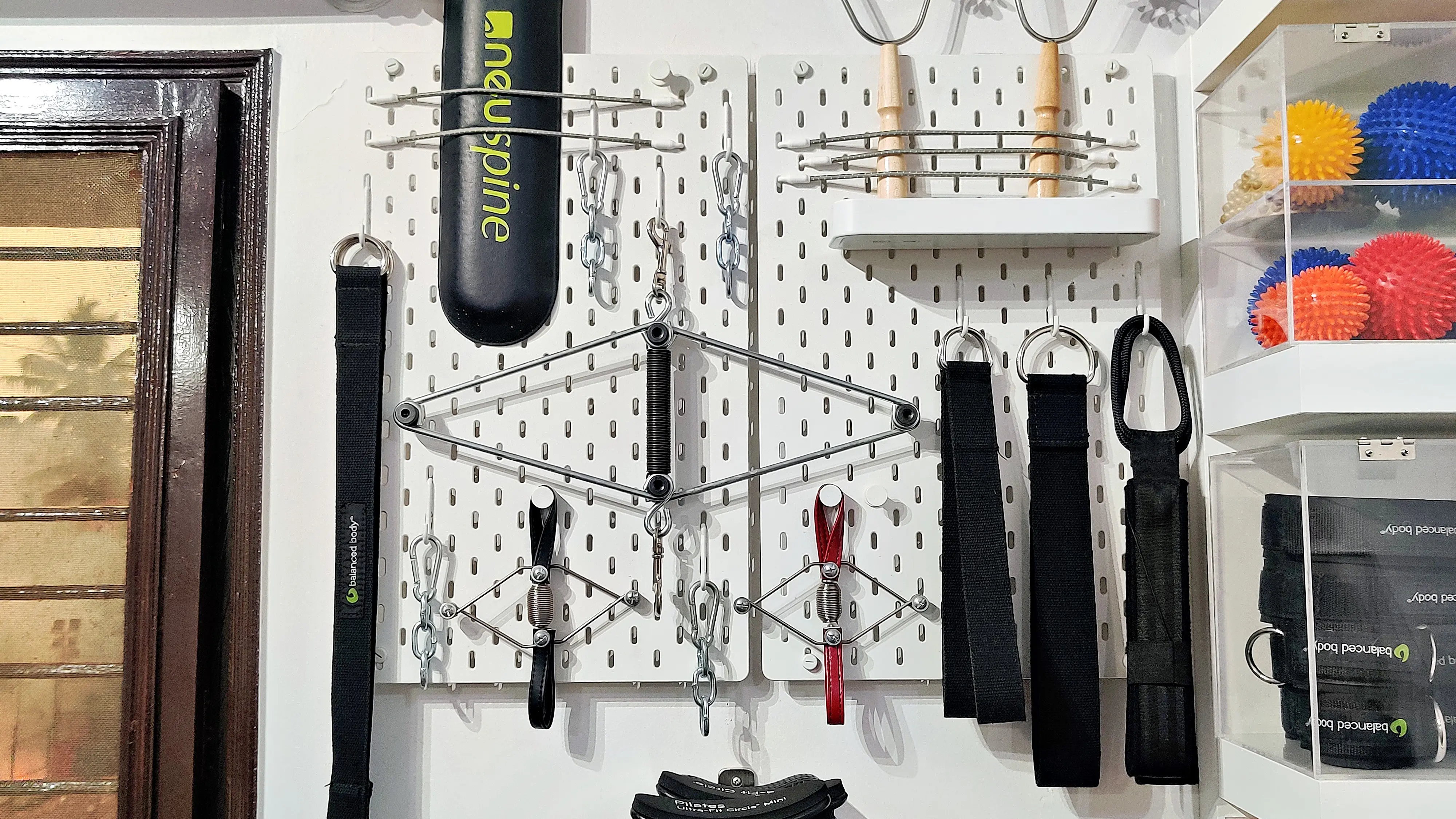
Every piece of small apparatus in the studio — the Foot Corrector, Toe Corrector, Spine Corrector, Bean Bag, Breath-a-cizer, Ped-O-Pul — receives the same level of inspection as any larger piece of equipment. Each of these tools is in the studio because it serves a specific purpose in the work. I inspect each piece for structural integrity, check any moving parts for smooth operation, clean surfaces after use, and replace any component that shows signs of wear or compromise.

The Ladder Barrel

The Ladder Barrel is a wooden apparatus and subject to the same expansion and contraction effects as the Reformer frame and the Cadillac in Bengaluru's climate. I check the rungs and the barrel frame regularly for any loosening caused by this movement and tighten hardware as needed. The barrel's upholstery follows the same cleaning and maintenance schedule as all other upholstered surfaces in the studio.

The Digital Maintenance Log

Every inspection, every maintenance action, every replacement is recorded in a spreadsheet. Date, apparatus, what was checked, what was found, what was done. This log is updated after every weekly deep inspection and after any maintenance event that happens outside the regular schedule.

The log makes it possible to query the history of any piece of equipment at any point. When were the Reformer springs last replaced? When was the last greasing done on the carriage wheels? When was the Cadillac canopy last cleaned? When were the leather straps last conditioned? All of this is in the record and can be retrieved immediately.

Most manufacturers specify replacement timelines for components — springs in particular — regardless of visible condition. A spring that looks fine may still be due for replacement based on age and usage. Without a log, tracking this relies entirely on memory. With a log, the timeline is visible and the replacement happens on schedule rather than when a problem eventually makes itself known.

I use the data to generate periodic reports — what has been done, what is coming due, what needs attention. This shifts the maintenance from reactive to proactive. Rather than waiting for a squeak, a mark, or a failure to signal that something needs attention, the log tells me what is coming before it arrives. That is the difference between maintaining equipment and managing it.

The Broader Principle

The maintenance routine I follow is not complicated. It is consistent. After every session, at the start of every day, at the end of every day, every week, every six months, every year — each of these has a specific set of actions associated with it. The actions are not particularly time-consuming. What makes them effective is that they happen reliably rather than only when something appears to be going wrong.

The apparatus my clients work on is part of the quality of every session. Equipment that is clean, properly maintained, and in good condition reflects the same attention to detail that I bring to the instruction. The two are not separate — they are the same standard expressed in different ways.

Maintenance is not housekeeping. It is part of the work.