Contrology: Separating the Method From the Mythology
Written by Abdul Kalam, Pilates instructor · For educational purposes only; not medical advice.
I began practicing Pilates in May 2016. My first private session. I have practiced in some form almost every day since — approaching a decade of daily practice as I write this. In close to ten years of practicing and teaching, I cannot recall a client describing a session as bad. You can have a bad day on a football pitch. A bad cricket game. A bad run or bike session. But a Pilates session that left someone worse than when they arrived — I have not encountered it, in my own practice or in anyone I have taught. That is an observation from one studio, offered as experience rather than evidence.
The method does not need embellishment. The experience of practicing it honestly and consistently is already remarkable on its own terms.
I am writing this because the Pilates world has accumulated a body of stories about Joseph Pilates that are repeated so frequently and with such confidence that they have come to be treated as established history. Some of these stories have a basis in fact. Some do not. And the distinction matters, because a method that needs mythology to support it is a method that does not fully trust its own value. Contrology does not need that. But it deserves honest representation.
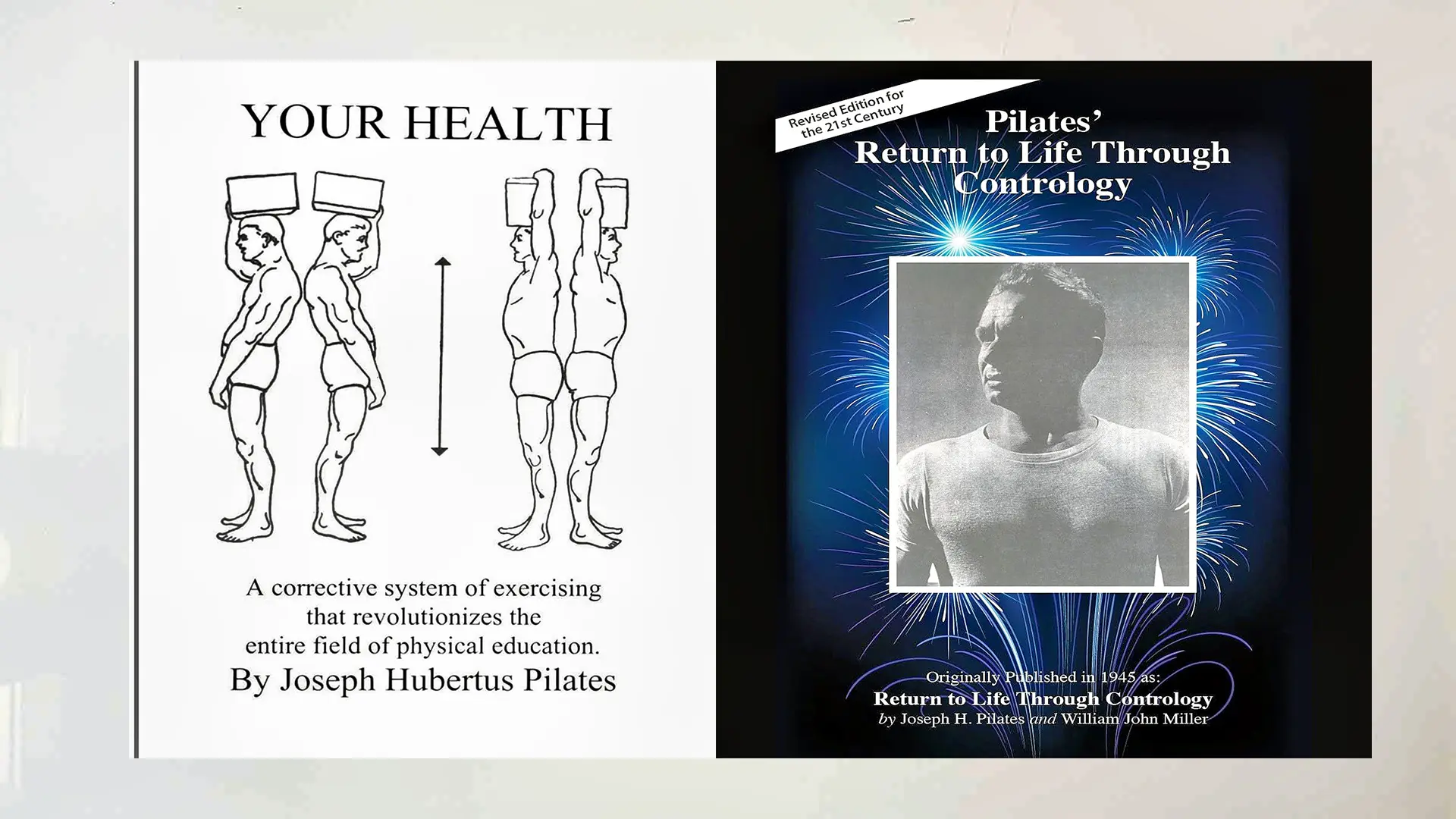
What follows is my attempt to examine the most widely repeated stories against what the historical record actually shows. I am not a historian. I am a Pilates instructor who has read both books Joseph Pilates published during his lifetime — Your Health (1934) and Return to Life Through Contrology (1945), both of which are in the public domain — and who has spent time researching the available sources. I may be wrong on some of this. I remain open to evidence that contradicts what I have written here.
What Is Confirmed
Joseph Hubertus Pilates was born on 9 December 1883 in Mönchengladbach, Germany. He was a sickly child — asthma, rickets, rheumatic fever — who committed himself from youth to physical development. He studied bodybuilding, gymnastics, boxing, diving, and the movement of animals. He arrived in England in 1912 and was interned at Lancaster Castle and then at Knockaloe Internment Camp on the Isle of Man when war broke out. He arrived at Knockaloe on 12 September 1915 and remained until March 1919.
His presence and activity at Knockaloe is documented by a primary source. The camp's own internal newspaper, the Lager Zeitung, records him as the referee at a boxing match in January 1917 — a document held at the British Library and referenced by the Knockaloe Charitable Trust, which has conducted the most thorough historical research on the camp. He published Your Health in 1934 and Return to Life Through Contrology in 1945. He died in New York on 9 October 1967. These are facts supported by the historical record.
The Internment Camp and the Spanish Flu
The most widely repeated story in the Pilates world holds that during his internment at Knockaloe, Joseph Pilates taught his exercises to thousands of fellow prisoners, and that not a single one of them died during the 1918 Spanish flu epidemic — proof of the power of his method.
The source of this claim is Joseph Pilates himself, in a 1962 Sports Illustrated interview — forty-four years after the events described. He told the interviewer that his students "ended the war in better shape than when it started, and when the great influenza epidemic came sweeping over all the countries that had fought in the war, not one of them came down with it." National Geographic, in a 2023 investigation of the Knockaloe records, noted plainly that "there is of course no evidence for the claim."
The actual mortality data tells a different story. A detailed analysis by Fletcher Pilates, drawing on research by historians Pont and Romero, found approximately 300 deaths attributable to Spanish flu in a camp population of 23,000 — a death rate of roughly 1.3%, lower than the global rate of 2.5%. Their analysis attributed this lower rate to geographical isolation — Knockaloe was on an island in the Irish Sea — and to the camp's practice of separating sick internees from healthy ones. Not to Pilates' exercises. Three hundred people died at Knockaloe. The claim that not one of his students was affected comes from a single interview, given four decades later, with no independent corroboration.
The Studio Fire and the Beam
A fire occurred at Joseph Pilates' studio at 939 Eighth Avenue, New York, in January 1966. That is confirmed. What is not confirmed is the dramatic version of events that circulates — that the elderly Pilates charged into the burning building, fell through the floorboards, and hung from a beam for hours until rescued, and that this incident led directly to his death.
This story has been directly contradicted by someone who knew him personally. Mary Bowen, one of the original Pilates Elders — first-generation students who trained directly with Joseph and Clara Pilates — addressed it on record. Her account, reproduced at Body Tech Pilates, is unambiguous: "The 82 year old Joseph Pilates did not charge into a burning smoke filled studio to rescue valuables, and firemen did not find him hanging from burning floor joists." She stated that Joseph Pilates died of advanced emphysema from years of cigar smoking — not from fire injuries. This is corroborated by his New York Times obituary, which records his death at Lenox Hill Hospital from emphysema.
The fire happened. The heroic rescue version did not — according to the people who were closest to him.
The Ten-Twenty-Thirty Sessions Quote
Perhaps the most universally repeated Pilates quote promises transformation in ten sessions, twenty sessions, and thirty sessions. It appears on studio walls, in marketing materials, in instructor training programmes, and across the internet in various slightly different phrasings. It is attributed to Joseph Pilates in virtually every instance.
I have read both of his published books carefully. This quote does not appear in either of them. I have searched for a verifiable primary source — a book page, an interview transcript, a dated publication — and found none. The quote aggregator A-Z Quotes lists dozens of his verified statements with specific book citations — but the 10-20-30 quote appears in the same list with no citation at all. That absence is significant. Where a citation exists, it is provided. Where it does not exist, the absence tells you something.
What Joseph Pilates did write — in Return to Life Through Contrology, quoted directly from the original 1945 text — is this:
"If you will faithfully perform your Contrology exercises regularly — only 4 times a week for just 3 months as outlined in Return to Life — you will find your body development approaching the ideal, accompanied by renewed mental vigor."
Four times a week. Three months. The mat exercises as outlined in his book. That is a specific, bounded, honest claim. It is what he actually wrote. The ten-twenty-thirty version — polished, parallel, and commercially convenient — has no verified source in anything he said or published.
The Bed Springs and the Reformer
The story that Pilates improvised the first Reformer by attaching springs from hospital beds to bed frames at Knockaloe has more basis than the other stories. The Knockaloe Charitable Trust's research confirms he worked with bedridden patients at the camp hospital and did devise spring-based apparatus to help them exercise. Pilates Anytime, in its historical overview, describes the bed spring origin as "a possibly apocryphal story" — acknowledging its uncertain status while noting the kernel of truth within it.
The principle of spring-assisted movement for bedridden patients does appear to originate at Knockaloe. What is less credible is the leap from improvised bed springs to the Reformer as a precision apparatus — with its carriage, calibrated spring resistance, footbar, and straps. That engineering required materials and manufacturing capability not available in a wartime internment camp. The Reformer as a functional instrument was clearly developed after Pilates arrived in New York in 1926. The idea may have begun at Knockaloe. The apparatus did not.
Why This Matters
I am not writing this to diminish Joseph Pilates or the work he created. The exercises exist. The apparatus exists. The method, practiced consistently with good instruction, produces results I have witnessed across a decade of daily practice and years of teaching. None of that depends on the stories being true.
What the mythology does is create a version of the method's origin that is more dramatic and more certain than the historical record supports. And that pattern — of claiming more than the evidence shows — is the same pattern that produces the back pain cure claims, the ten-twenty-thirty guarantee, and the overclaiming that makes honest conversation about the method harder than it needs to be.
Joseph Pilates designed something genuinely valuable. It does not need embellishment. What it needs is practitioners who understand it clearly, teach it honestly, and let the experience of practicing it speak — which, in my experience, it is more than capable of doing without any assistance from legend.
The stories that circulate about Joseph Pilates deserve the same honest examination we would apply to any claim made about the method. Some are founded. Some are not. The method itself — the exercises, the apparatus, the principles he documented in his own books — stands entirely independently of all of them.
Sources referenced: Wikipedia — Joseph Pilates · Knockaloe Charitable Trust · National Geographic — The Exercise Phenomenon Born in a POW Camp (2023) · Fletcher Pilates — Confinement and Pandemic in 1918 · Body Tech Pilates — Mary Bowen on the studio fire · Pilates Anytime — Pilates History · Return to Life Through Contrology, Joseph H. Pilates and William J. Miller, J.J. Augustin, 1945 (public domain) · Your Health, Joseph H. Pilates, 1934 (public domain)