The Art of Cueing in Pilates Instruction
Written by Abdul Kalam, Pilates instructor · For educational purposes only; not medical advice.
When I began teaching I followed the order. Exercise by exercise, session by session, exactly as I had been taught. That was the right place to start. You learn the method first. You learn the sequence. You learn what each exercise is asking of the body and how it connects to what comes before and after. That foundation matters — without it there is nothing to build on.
But at some point in my teaching, something shifted. I realised that the order was not the lesson. The order was the container. The real work — the thing that actually changes how someone moves — is what happens inside it. How an exercise is delivered. What is said, when it is said, and to which body it is said.
That realisation changed everything about how I teach.
The Body in Front of You
I do not prepare lesson plans. This is not laziness — it is a considered position. A lesson plan assumes I know in advance what the client needs. I do not. I know what they needed last week. I know their movement history and their patterns. But I do not know what they are carrying into the studio on any given day until they are in front of me and moving.
A client who slept badly moves differently from one who is rested. A client who has been at a desk for ten hours carries that compression into the first exercise. A client who is anxious holds their breath differently from one who arrives calm. None of this is visible until the session begins. The lesson plan belongs in the bin before it starts.
What I bring instead is attention. Full, undivided attention on this body, today, in this session. The exercises themselves can be straightforward or demanding depending entirely on how the information is relayed and how the client interprets it. There is no need to constantly introduce new exercises to create challenge — diving deeper into existing ones, with more precise cueing, produces far more meaningful results.
Same Exercise, Different Instruction
Take the Roll Up — one of the most fundamental exercises in the mat sequence. I have taught it hundreds of times. I teach it differently every time.
To a client who is healthy and strong, the instruction might be about slowing down — resisting the pull of momentum, finding the sequential articulation of each vertebra rather than using the hip flexors to haul the body upright. The challenge for this client is precision, not effort.
To a client with hypermobility the instruction is entirely different. The joints move too freely — the work is about finding stability within that range, about engaging the deep support structures before the movement begins rather than relying on passive joint flexibility to carry them through it.
To an older client the instruction changes again — the range may be smaller, the pace slower, the priority a clear breath pattern that supports the movement rather than fights it.
Same exercise. Same name. Three completely different bodies, three completely different instructions. The body in front of you is the only plan that matters.
What I Say and How I Say It
I do not use elaborate language. I do not dramatise. I say what needs to be said, in as few words as possible, at exactly the moment the body can receive it. Every word should serve the movement — move the client, connect them to what is happening, help them find something they have not yet found.
There is a discipline to this that took years to develop. Early in teaching there is a temptation to explain — to justify the instruction, to give context, to fill silence with helpfulness. I have learned that most of that talking gets in the way. The client is moving. Their attention is on their body. A long sentence competes with that attention. A short, precise phrase lands directly.
The rhythm and tone of the cue matters as much as the words. The way you say "lift" or "lengthen" or "exhale" should match the pace and quality of the movement itself. A cue that arrives at the wrong moment — after the body has already passed the point where it could act on it — is wasted. Timing is not secondary to content. It is equal to it.
I say the same things again and again. Not because I have run out of cues but because the fundamental things — breathe, find your centre, let the spine move sequentially — need to be said repeatedly across hundreds of sessions before they become integrated. Novelty is not the goal. Precision is.
Verbal Language and Touch
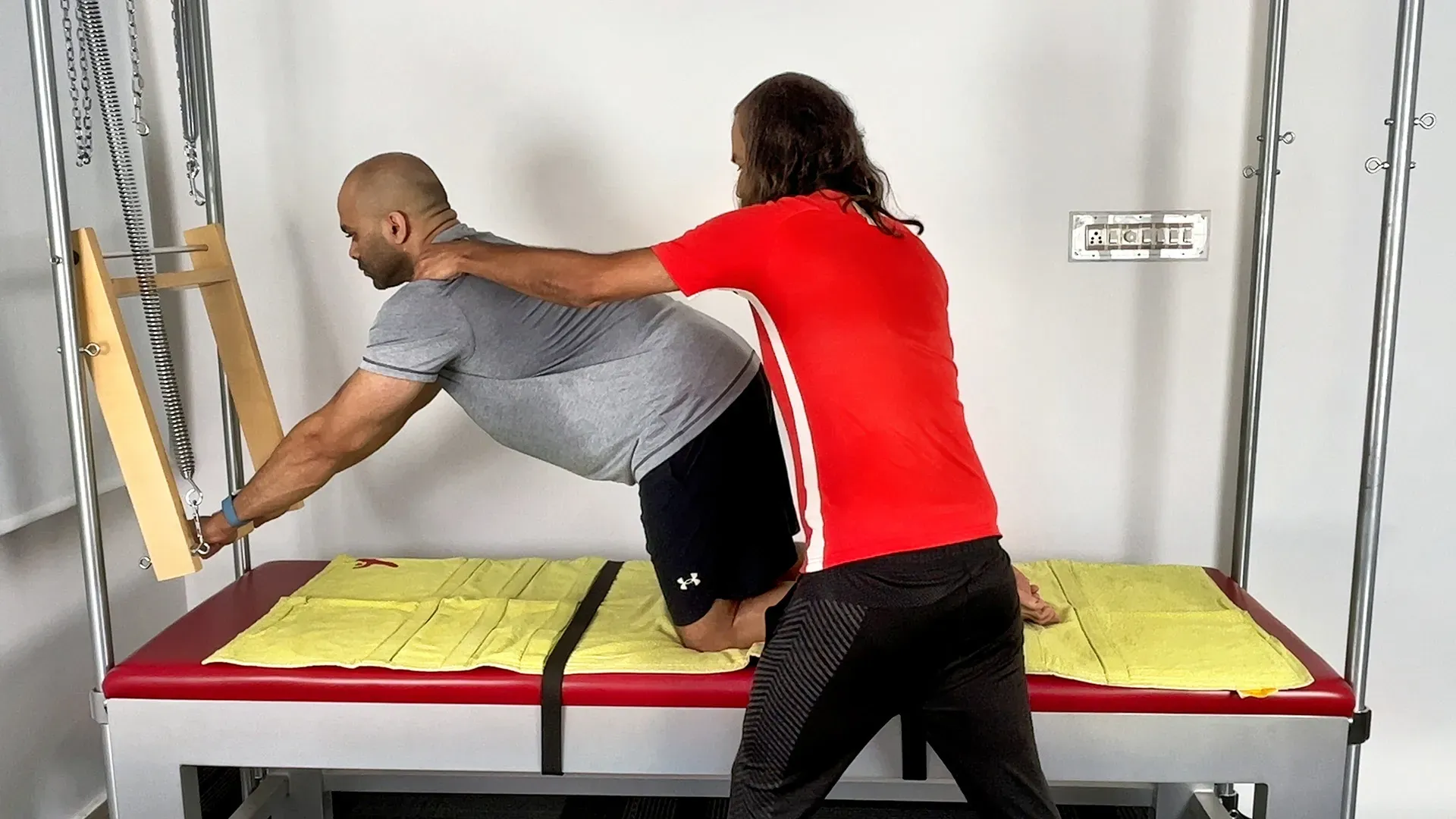
Cueing can be verbal or through touch. Both have their place. When touch is used, it should always be an invitation for the client to respond — never forceful, never manipulative. The client must be comfortable with hands-on guidance, and that comfort is established over time through the working relationship.
Verbal cues should be clear and concise. Solid anatomical knowledge matters for the instructor — but not all clients share that knowledge, and assuming they do creates confusion. Hip bones rather than anterior superior iliac spine. Collar bones rather than clavicles. Hamstrings rather than a list of their technical names. The goal is to direct the client's attention precisely, not to demonstrate the instructor's knowledge of anatomy.
Imagery can be a powerful tool when used well. A well-chosen image gives the body a felt sense of what is being asked before the conscious mind translates the instruction into movement. But images need to be relevant and easily understood by this particular client. An image that sends the client into confusion — wondering what was meant — has moved their attention away from the work. That is the opposite of what cueing is for.
Four Things I Think About
When I cue, there are four things running simultaneously. First — what does this client need right now, in this moment, in this movement? That is always the starting point. Second — what specific words will direct their attention there? "Lengthen the back of the neck" lands differently from "relax your shoulders" — even if the physical outcome is similar. One gives the body a direction. The other asks it to stop doing something.
Third — is a direct instruction the right tool, or does this client need an image to bridge the gap between what I am asking and what their nervous system understands? Some clients respond immediately to anatomical direction. Others need a metaphor that gives the body a felt sense of the movement first. Knowing which approach this client needs, and when, comes only from sustained observation over time.
Fourth — delivery. Not just what is said but when, at what volume, at what pace, with what tone. Timing and tone are as much a part of the instruction as the words themselves.
Cueing at Different Stages of Practice
How much to cue depends on where the client is in their practice. A client who is new to the method needs to know what to do — and less is more. Overloading a beginner with cues leads to confusion and frustration. The most useful thing at that stage is consistent, clear direction about the centre — where it is, how to find it, how to maintain it through movement. Everything else can wait until the fundamental connection is more established.
As the client progresses — as they learn the exercise names, move through transitions with greater ease, maintain their centre through longer sequences without breaks — the cueing can deepen. Now the work is fine-tuning. A client who knows what they are doing is ready to be told how to do it better. That is when the most productive cueing happens: not correction of what is wrong, but refinement of what is already working.
There are also moments when the right thing to do is say nothing. Pilates is a process. Not every movement needs fixing, and sometimes it is more valuable to let the client have the experience of working through something without the instructor intervening. Knowing when to hold back is as important as knowing when to speak.
What I Am Working Toward
The goal of cueing, as I understand it, is its own obsolescence. The client who needs constant instruction has not yet internalised the work. The client who can self-correct — who notices when the breath is held, who feels when the pelvis has shifted, who can find the movement without being told — has developed something far more valuable than the ability to follow instructions well.
In practical terms this means something specific. A client who has worked consistently over time should know the names of the exercises they practice. They should understand what different spring configurations do — why more springs provide support and fewer springs increase challenge — and be able to make that choice themselves when it is appropriate. They should know how to adjust the apparatus safely and handle the equipment with confidence. These are not peripheral details. They are evidence that the client has developed a relationship with the work rather than a dependence on the instructor to manage it for them.
When a client can walk into the studio, set up the Reformer for footwork at the spring weight that suits them that day, and begin working with genuine understanding of what they are doing and why — that is the goal of the instruction. Not performance. Not compliance. Informed, independent practice that continues to develop whether the instructor is in the room or not.
Not every client responds to the way I work. I am direct. I am specific. I do not soften the instruction with unnecessary pleasantries. The session belongs to the work, not to the conversation around it. Some people find that style uncomfortable. That is fine — this studio is not for everyone, and I have never tried to make it so.
The instruction that lands is not the cleverest one or the most elaborate one. It is the one given to the right body, at the right moment, in exactly the right words. That precision does not come from a lesson plan. It comes from years of paying attention.