The Apparatus and the Springs
Written by Abdul Kalam, Pilates instructor · For educational purposes only; not medical advice.
When a prospective client first encounters Pilates, two things draw their attention before anything else. The apparatus. The springs.
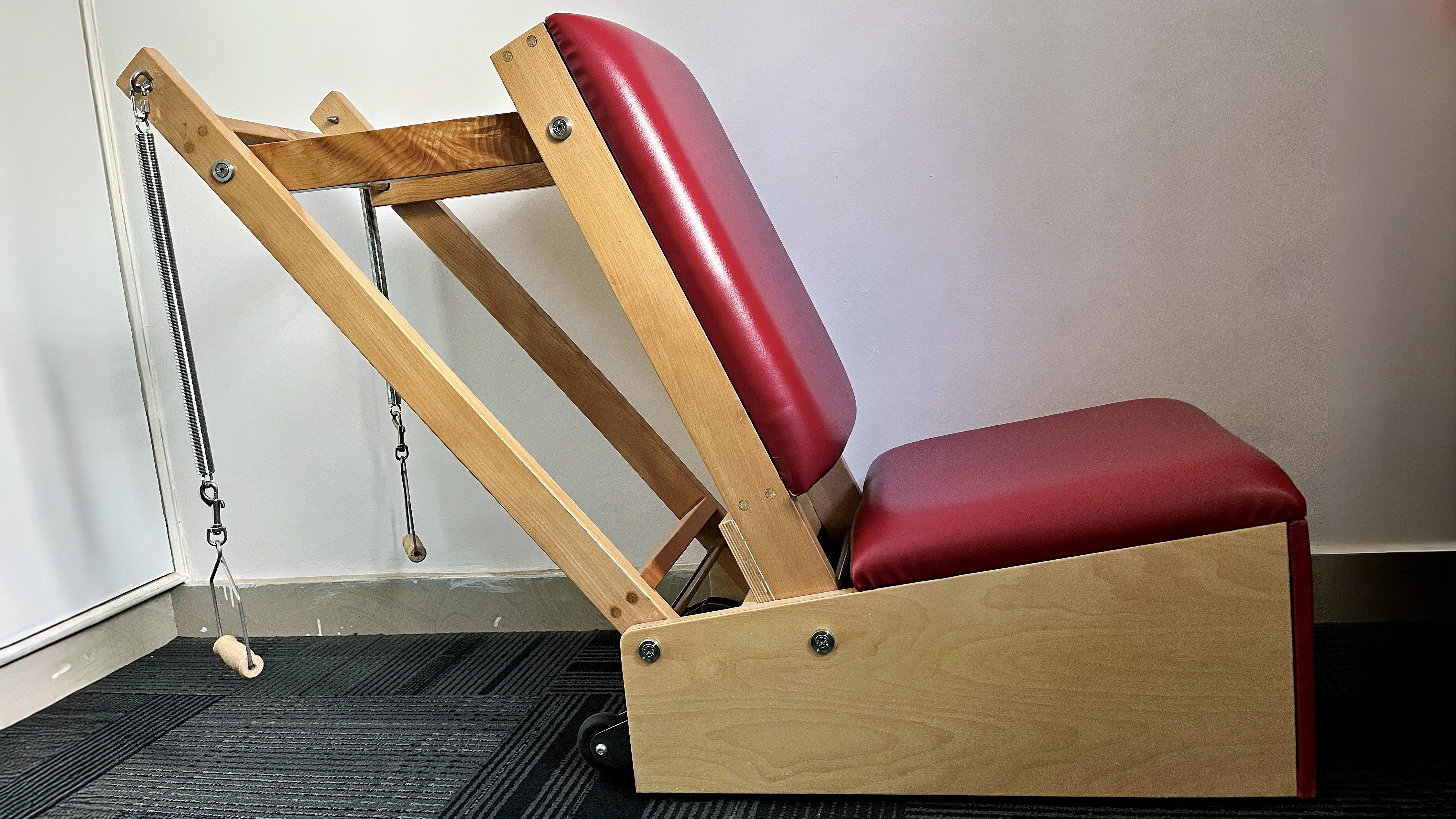
The Reformer with its sliding carriage. The Cadillac with its trapeze and push through bar. The Wunda Chair with its pedal and springs. The Spine Corrector with its barrel curves. These are visually distinctive in a way that other movement modalities are not. Someone walking past the studio sees something they have not seen before.
The questions that follow are predictable. What is this equipment for? Is it like the machines in a gym, designed to exercise specific body parts? How heavy are the springs — are they like five-kilogram weights, ten-kilogram weights? Which apparatus is for the legs? Which is for the arms? Which is for the back?
These are reasonable questions to ask. They often come from a familiar context for exercise equipment — the gym, where some machines emphasise particular muscle groups and loads are commonly described in standardised increments. The questions assume that Pilates equipment works the same way and that the answers will fit the categories the questioner already has.
The questions do not fit. The categories do not transfer. This is not because Pilates is mysterious or special. It is because the apparatus and springs are being used within a different teaching framework, and that matters for understanding what the practice involves.
What the Apparatus Is For
Many people first interpret Pilates apparatus through their experience of gym equipment. Some gym machines guide movement or emphasise particular muscle groups; others involve several joints and muscle groups. The categories are varied and do not transfer neatly from one kind of equipment to another.
In the way I use Pilates apparatus, it provides combinations of support, resistance, constraint and feedback while the body works in a coordinated way. Different apparatus alter those conditions and give me different ways to observe the same person.
In my teaching, the apparatus has two closely related purposes.
The first is support. The apparatus provides specific kinds of support — through the carriage, the springs, the trapeze, the box, the pedal — that allow the body to work with movement patterns it may not yet be able to perform with control under gravity alone. The support is not making the work easier in the sense of less demanding. It is making the patterns accessible for the kind of attention and repetition the method requires.
The second is observation. Each apparatus gives me a different angle from which to see how a client's body is organising itself. The Reformer lets me see how the body moves in a supine or kneeling position, what the pelvis does as the legs press out, how the spine articulates when the body folds. The Wunda Chair gives me a seated side view in a small footprint, where I can observe how the spine sequences during forward bending or how the hip flexors engage during single-leg work. The Cadillac lets me work with the client in positions that are not approached in the same way on the other apparatus I use — inverted, suspended and supported from above. The Spine Corrector lets me see what happens when the natural curves of the spine are accentuated.
Each piece of apparatus is a vantage point. Together they let me see the body in many configurations, and what I see in each configuration informs how the work proceeds.
Clients sometimes ask whether the specific brand of apparatus matters — whether a Reformer made by one manufacturer is meaningfully different from a Reformer made by another. Apparatus varies by manufacturer and model in its dimensions, materials, spring system, adjustment options and maintenance requirements. Those differences affect setup and feel. I work within the specifications of the apparatus in front of me and follow the applicable manufacturer guidance.
A teacher must understand both the method and the particular apparatus being used. The equipment must be appropriate to the exercise, maintained correctly and used within its manufacturer's specifications. The apparatus does not do the teaching on its own.
In my teaching, the apparatus is not only a source of resistance. It is also a source of support, constraint, feedback and observation.
What the Springs Do
The springs are the part that draws the most curiosity, partly because they are the most visible mechanism and partly because they are the part that prospective clients most want to compare to weights.
Springs differ from fixed external loads because their force changes as their length changes. As a spring is extended, it produces a restoring force towards its resting position. The amount and direction of that force depend on the spring, the apparatus setup and where the body is within the movement.
A spring can therefore resist one phase of an exercise and assist another. It can also provide feedback: changes in control, timing or symmetry may become visible through the movement of the carriage, pedal or bar.
Spring choice cannot be reduced to a single rule that more springs are easier or fewer springs are harder. Adding springs increases the force produced by the spring system. Whether that functions mainly as resistance, assistance, or a combination of both depends on the exercise.
Reformer Footwork is one example. Increasing the spring force makes pressing the carriage away require more force, while also producing a stronger pull towards closure. Reducing the spring force decreases both effects. The setting changes the demands in each phase rather than simply moving the exercise up or down one scale of difficulty.
The effect can be counterintuitive because the same spring setting may resist one phase and assist another. Spring choice remains important because it changes the force, feedback and assistance available throughout the movement.
How I Decide What Springs to Use
The training I went through provided a framework — a chart of spring configurations for different exercises and body considerations. That framework remains a reference, alongside the specifications and guidance for the apparatus being used.
But the framework is not the answer to the question of how many springs a specific body should use on a specific day for a specific exercise. The answer comes from what I see in the body in front of me. How is the body moving? What support does it need to move with integrity? Where is it compensating, and would more support give the body a clearer path, or would less support ask the body to find more of its own organisation?
This judgement develops through teaching, but it remains bounded by the training framework and applicable manufacturer guidance. Observation informs the choice within those limits; it does not replace them.
The appropriate setting depends on the exercise, the body position, the apparatus and the spring system. Settings that appear similar across two manufacturers may not produce equivalent forces, so spring choices are not transferred mechanically from one apparatus to another.
How I Understand the Relationship Between Apparatus and Mat
In the teaching tradition I follow, the apparatus and the Mat are parts of one system. The apparatus can provide support, resistance and feedback that allow a person to work with patterns that also appear in Mat work.
In many cases, I use the apparatus as a bridge towards performing a movement with less external assistance. That does not mean every apparatus exercise exists only to lead to a Mat exercise, or that Mat work is the only destination. It describes one important relationship between the different parts of the system as I was taught to use them.
The Saw: One Exercise Across Four Apparatus
Versions of the Saw appear on the four apparatus discussed here. In the versions I was taught, the same rotational and forward-reaching pattern is organised under different conditions.
On the mat, the saw is performed seated, legs extended wide, arms outstretched. The body rotates, then folds forward over one leg, with the opposite hand reaching past the foot in a sawing motion. The exercise requires hip mobility, spinal rotation, hamstring length, and the deep integration of trunk and limbs that the mat asks for.
On the Reformer, a version of the saw can be performed seated on the short box, with the body twisting and reaching toward the foot in a similar pattern. The box provides a stable surface, and the apparatus configuration changes what the body has to manage. The seated stomach massage with twist offers another related pattern, where the rotation and forward reach occur with the legs working against the spring.
On the Cadillac, the saw can be performed using the push-through bar, with the springs assisting from above. The body works in a similar rotational and folding pattern, but the support from the push-through bar changes the dynamic of the movement. The bar gives the body something to organise against, and the springs from above provide assistance for the forward reach.
On the Wunda Chair, the saw can be performed standing alongside the chair, with the rotational and folding pattern using the pedal and the springs from below. The standing position changes the gravitational demand. The springs change the resistance profile.
A client who has practised the saw across several apparatus encounters the same movement pattern under different conditions. Each version contributes specific support and specific demands. The Reformer version works with seated rotation and spring resistance. The Cadillac version works with rotation and support from above. The Chair version changes the demand by placing the pattern in standing. The mat version asks the body to organise the rotational forward fold without apparatus support.
Working the saw across the apparatus over time can prepare the body for the mat saw. The mat saw is the version where the body has to organise itself for the rotational forward fold without external support, and the apparatus versions give the body different ways to practise the coordination, strength, and mobility the movement asks for.
Related patterns also appear across apparatus. Teaser, the Hundred and Spine Stretch are examples. In the sequence I was taught, working with these patterns under different conditions can help prepare the body to organise them with less external support.
What This Means in Practice
The visual form of the apparatus often creates the first questions, but its appearance does not explain how it is used. The apparatus and springs are parts of the teaching environment, not the whole of the method.
The method works with movement patterns through the particular support, resistance, constraint and feedback that the apparatus provides. Springs alter the force available through different phases of movement and can make changes in timing, control and organisation visible.
The apparatus is not the answer to the question of which machine works which body part. The springs are not the answer to the question of how much weight you are lifting. These are questions from a different framework, and trying to fit Pilates into that framework produces confusion rather than clarity.
In this studio, the apparatus is used for coordinated whole-body teaching. The springs alter resistance, assistance and feedback according to the exercise and setup. The work is the practice of organising movement within those changing conditions.